The Quiet Signals of a Good Listener (and the Ones That Say “I’ve Checked Out”)
Listening has a visible, audible structure: tiny signals, near-instant timing, and the steady proof that someone is actually with you. Here’s how to read and send them.
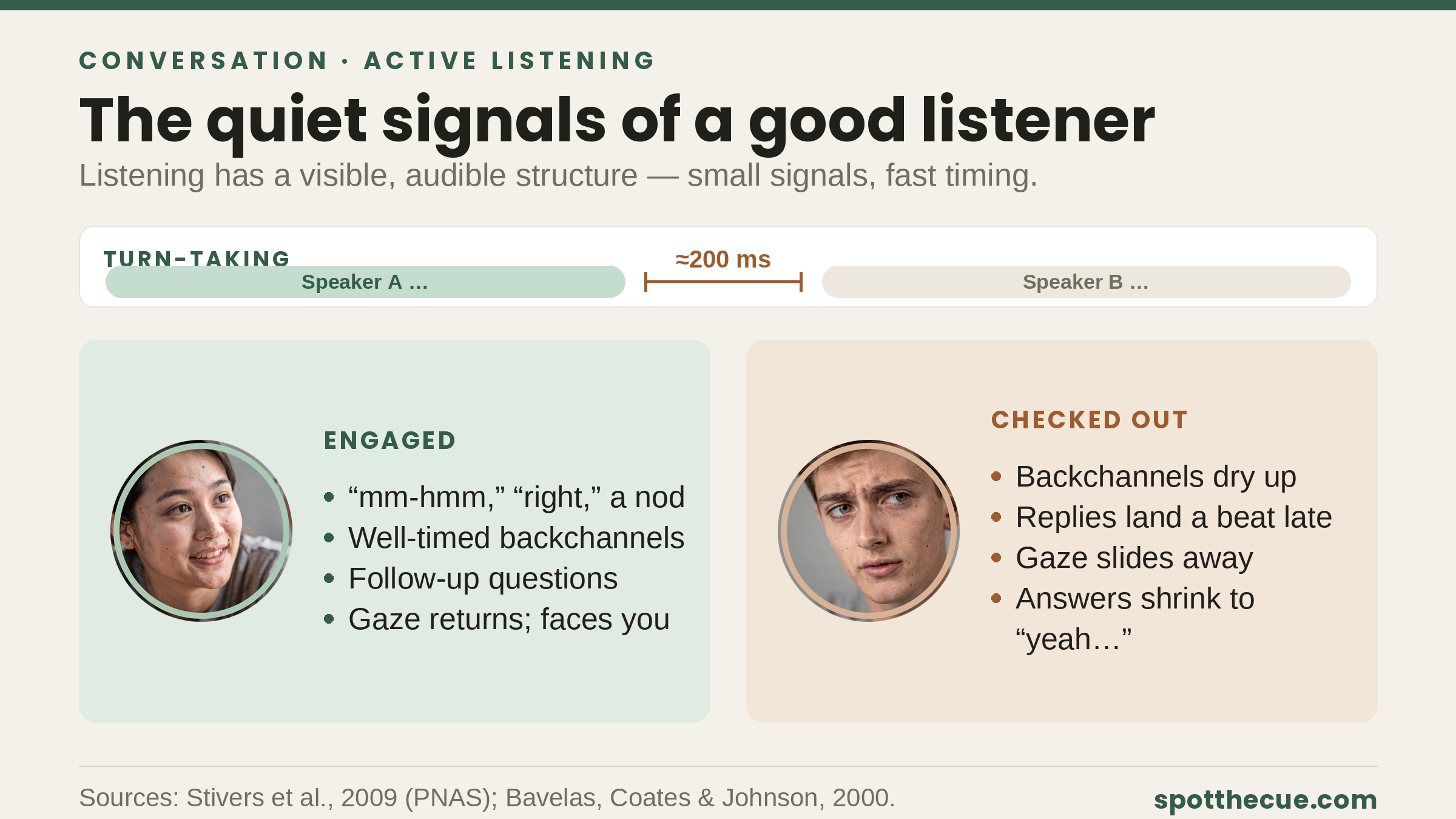
Listening is something you can see and hear
Good listening isn’t silent and still. It has a structure made of small signals. The linguist Victor Yngve named the most basic one in 1970: the backchannel — the "mm-hmm," "yeah," "right," and small nods a listener sends while the speaker keeps the floor.1 They say "I’m with you, keep going" without taking over.
The clockwork of taking turns
Conversation runs on a precise turn-taking system: broadly, one person talks at a time, and we minimize gaps and overlaps.2 How precise? A cross-linguistic study of ten languages (from English to Japanese to a Papua New Guinea language) found the most common gap between turns clusters around 200 milliseconds, roughly a fifth of a second.3 Since it takes longer than that to plan a reply, we’re predicting the end of the other person’s turn while they’re still talking.
Disengagement leaks into the conversation
When someone stops really listening, it shows, and it changes the speaker. In one study, listeners distracted by a side task produced fewer and worse-timed backchannels, and the speakers, sensing it, told their stories markedly less well, especially at the dramatic ending.4 A good listener is closer to a co-author than an audience.
Signs someone is drifting: backchannels dry up or land in the wrong place, replies come a beat too late, gaze slides away and returns, the body angles toward the exit, and answers shrink to "yeah… totally." None is proof on its own, but together they’re a reliable cluster.
Why it’s worth getting right
Being listened to well does real work. In experiments, speakers who experienced high-quality listening became less defensive about their own views and more willing to acknowledge two sides of an issue.5 And a large 2024 meta-analysis tied feeling listened-to at work to better performance, higher wellbeing, and lower burnout.6 Listening isn’t just polite. It changes outcomes.
Backchannel sincerely
Small, genuine signals (a nod, a quiet "mm-hm," a brief "that makes sense") beat performed enthusiasm. They tell the speaker you’re tracking.
Don’t race the gap
You don’t need to fill every 200ms. Let a beat land before replying; it signals you took the words in rather than waiting to talk.
Ask the follow-up
The strongest proof of listening is a question that could only come from having heard the last thing they said.
Reflect, then check
Briefly say back what you understood ("so the deadline’s the real problem?"). It both confirms and makes the other person feel genuinely heard.
Now try reading a cue under a little pressure.
Short scenarios, instant feedback. Free to start, no sign-up.
Sources
- Yngve, V. H. (1970). On getting a word in edgewise. Papers from the Sixth Regional Meeting, Chicago Linguistic Society, 567–578.
- Sacks, H., Schegloff, E. A., & Jefferson, G. (1974). A simplest systematics for the organization of turn-taking for conversation. Language, 50(4), 696–735. Link ↗
- Stivers, T., Enfield, N. J., Brown, P., Englert, C., Hayashi, M., Heinemann, T., … Levinson, S. C. (2009). Universals and cultural variation in turn-taking in conversation. PNAS, 106(26), 10587–10592. Link ↗
- Bavelas, J. B., Coates, L., & Johnson, T. (2000). Listeners as co-narrators. Journal of Personality and Social Psychology, 79(6), 941–952. Link ↗
- Itzchakov, G., Kluger, A. N., & Castro, D. R. (2017). I am aware of my inconsistencies but I can tolerate them: The effect of high-quality listening on speakers’ attitude ambivalence. Personality and Social Psychology Bulletin, 43(1), 105–120. Link ↗
- Kluger, A. N., Lehmann, M., Aguinis, H., Itzchakov, G., et al. (2024). A meta-analytic systematic review and theory of the effects of perceived listening on work outcomes. Journal of Business and Psychology, 39, 295–344. Link ↗