Why Practicing Social Moments Out Loud Works (and How to Do It)
Rehearsing in your head is better than nothing, but saying it out loud is what actually builds the skill. Here’s the research, and how to practice well.
Most of us “practice” conversations in our heads — replaying an awkward exchange, scripting what we’ll say next time. Silent rehearsal is better than nothing, but it skips the part that actually builds the skill: doing it out loud.
Acting it out beats thinking it through
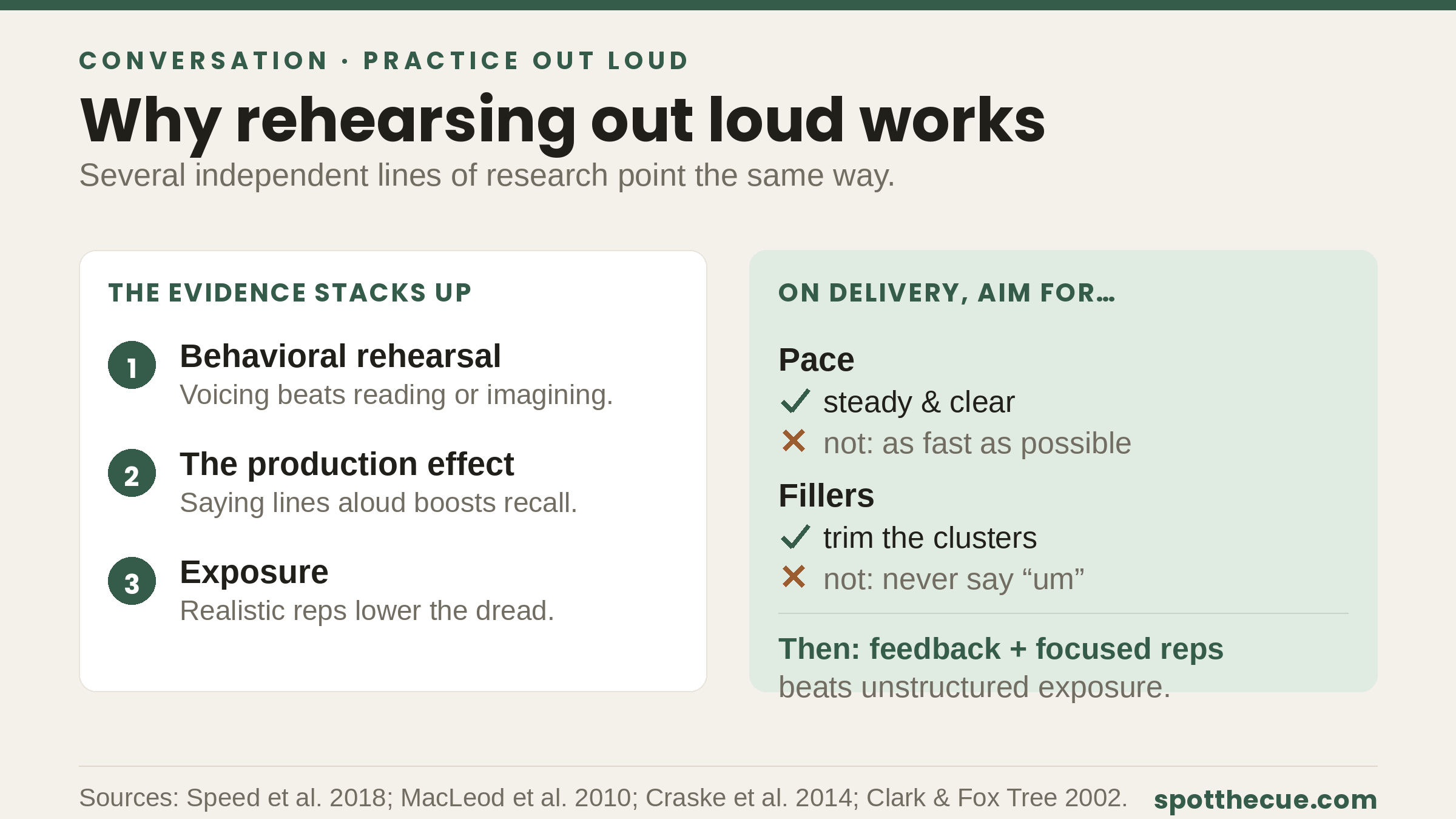
Behavioral rehearsal means actually voicing a social interaction rather than just reading or imagining it. It is a core, evidence-based ingredient of social-skills and assertiveness training, and rehearsing out loud outperforms passive methods like reading or journaling on the very behaviors you practice.1 The catch every review repeats: those gains transfer to real life best when you practice in realistic conditions and keep getting reps.
Saying it out loud makes it stick
There’s a reason a line you’ve said aloud comes back to you more easily than one you only read. It’s called the production effect: producing words out loud during practice improves later memory for them (typically a 10–20% boost over silent reading), and it’s one of the most reliable findings in memory research.23 A rehearsed opener or response is simply more available when you’re under pressure.
Rehearsal is how you turn down the dread
Avoiding a feared conversation keeps the fear intact; rehearsing it under realistic conditions is how the dread comes down. That’s the principle behind exposure in CBT, now understood as inhibitory learning: you learn the feared outcome usually doesn’t happen, especially when you compare what you expected with what actually occurred.4 And simulated practice transfers: in trials of virtual job-interview training, people who rehearsed with a simulated interviewer were more likely to land a real job offer months later.5
What good delivery actually sounds like
Myth Good speakers never say “um” — eliminate every filler word.
What the research says Occasional, natural disfluencies are normal and can even help listeners follow you: an “uh” or “um” signals that something is coming and can speed up how quickly people process your next word.6 What actually reads as less confident and competent is dense, frequent filler.7 The useful goal is trimming the clusters, not policing every pause.
Pace works the same way: there’s no magic number. A steady, comfortable rate tends to read as confident, but faster isn’t automatically more persuasive; whether a brisk pace helps or hurts depends on the message and the listener.8 Aim for steady and clear, not fast.
Practicing out loud: what to listen for
Say it, don’t just think it
Voice the actual words. Imagined rehearsal skips the production and delivery your brain most needs the practice on.
Aim for a steady pace
Comfortable and clear beats fast. Consistency reads as more confident than speed.
Trim the dense filler
You don’t need to erase every “um.” Target the clusters, and let natural pauses do their job.
Practice out loud in Spot the Cue
This is exactly what the app’s out-loud practice is built for. You pick a real moment, like declining an invitation without over-explaining, giving a coworker feedback, or answering “tell me about yourself,” and say your response aloud. It runs entirely on your device (microphone and transcription included), so it stays free and private, and it reflects back the delivery cues that are hard to hear in the moment: your speaking pace, filler-word count, and pauses. Each scenario also gives you a model answer and the common pitfalls to compare against, so you know what “landing it” sounds like.
Now try reading a cue under a little pressure.
Short scenarios, instant feedback. Free to start, no sign-up.
Sources
- Speed, B. C., Goldstein, B. L., & Goldfried, M. R. (2018). Assertiveness training: A forgotten evidence-based treatment. Clinical Psychology: Science and Practice, 25(1), e12216. Link ↗
- MacLeod, C. M., Gopie, N., Hourihan, K. L., Neary, K. R., & Ozubko, J. D. (2010). The production effect: Delineation of a phenomenon. Journal of Experimental Psychology: Learning, Memory, and Cognition, 36(3), 671–685. Link ↗
- MacLeod, C. M., & Bodner, G. E. (2017). The production effect in memory. Current Directions in Psychological Science, 26(4), 390–395. Link ↗
- Craske, M. G., Treanor, M., Conway, C. C., Zbozinek, T., & Vervliet, B. (2014). Maximizing exposure therapy: An inhibitory learning approach. Behavior Research and Therapy, 58, 10–23. Link ↗
- Smith, M. J., et al. (2015). Virtual reality job interview training and 6-month employment outcomes for individuals with schizophrenia seeking employment. Schizophrenia Research, 166(1–3), 86–91. Link ↗
- Clark, H. H., & Fox Tree, J. E. (2002). Using uh and um in spontaneous speaking. Cognition, 84(1), 73–111. Link ↗
- Kirkland, A., et al. (2023). Pardon my disfluency: The impact of disfluency on the perception of speaker competence and confidence. Proc. Interspeech 2023. Link ↗
- Smith, S. M., & Shaffer, D. R. (1995). Speed of speech and persuasion: Evidence for multiple effects. Personality and Social Psychology Bulletin, 21(10), 1051–1060. Link ↗
- Ericsson, K. A., Krampe, R. T., & Tesch-Römer, C. (1993). The role of deliberate practice in the acquisition of expert performance. Psychological Review, 100(3), 363–406. Link ↗
- Macnamara, B. N., Hambrick, D. Z., & Oswald, F. L. (2014). Deliberate practice and performance in music, games, sports, education, and professions: A meta-analysis. Psychological Science, 25(8), 1608–1618. Link ↗