The Cue Most People Miss: A Real Smile vs. a Polite One
The difference between a felt smile and a social one is written around the eyes. Here’s what to look for, and why it’s a probability rather than a lie detector.
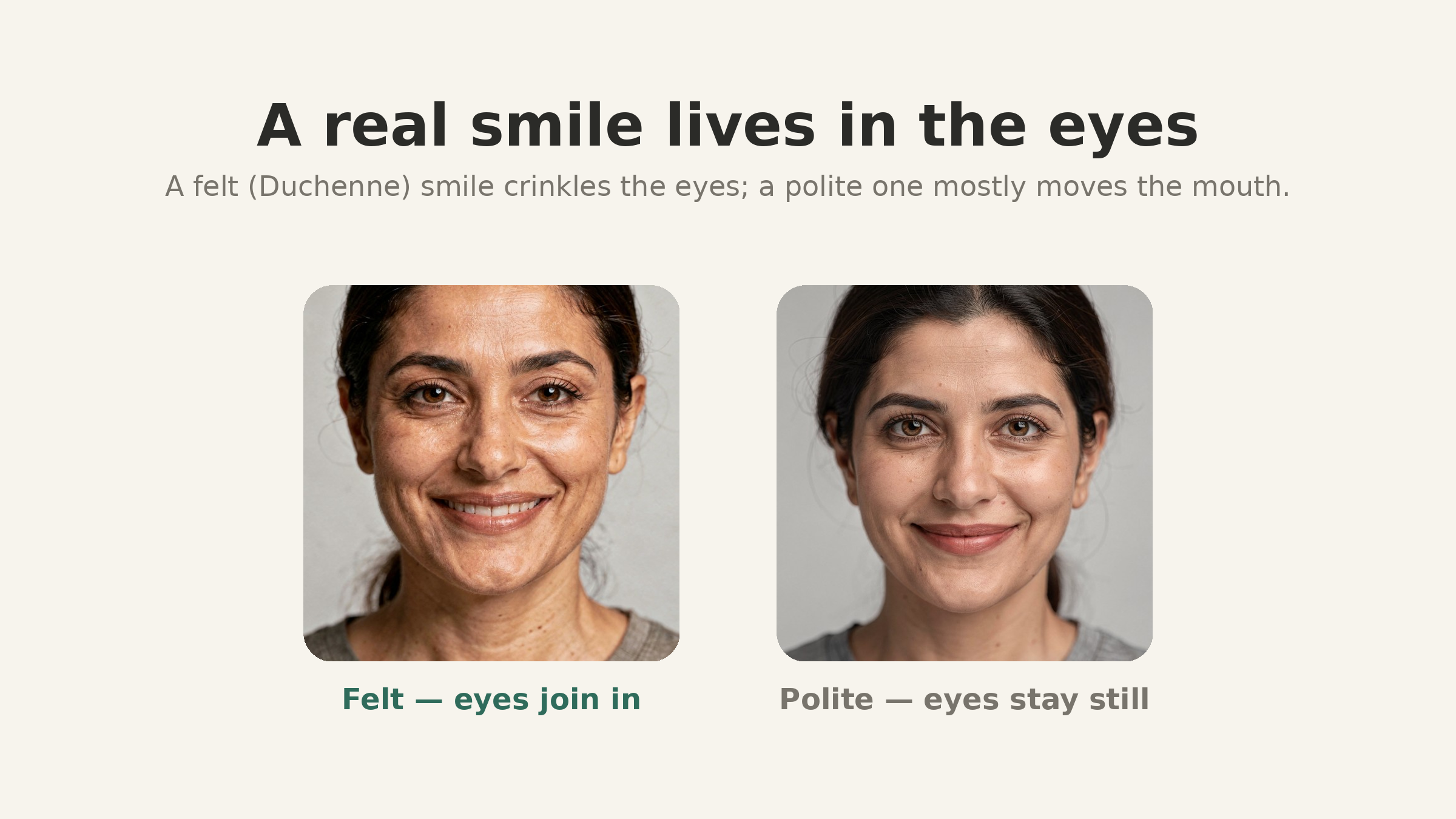
The cue is in the eyes
A polite smile mostly uses one muscle: the zygomaticus major, which pulls the lip corners up. A felt smile recruits a second one: the orbicularis oculi, the ring of muscle around the eye. That second muscle raises the cheeks, narrows the eyes slightly, and produces the little crow’s-feet at the outer corners.5
The distinction is over 150 years old. In 1862, the French physiologist Duchenne de Boulogne noted that the eye muscle is "only put in play by a true feeling, an agreeable emotion" — which is why genuine smiles now carry his name.1 A century later, Ekman, Davidson, and Friesen found that these eye-involving smiles showed up more during real enjoyment and were accompanied by a distinctive pattern of brain activity.2
What to actually look for
The eyes, not the mouth
Cheeks lifting and faint crow’s-feet at the outer eye corners are the tell. A wide mouth with calm, uninvolved eyes is usually a social smile.
Timing
Felt smiles tend to appear and fade smoothly and fit the moment. A smile that snaps on, holds too long, or arrives a beat late is more often deliberate.
The rest of the face
A genuine smile usually softens the whole face. If the brow and eyes stay tense, the smile may be doing social work rather than expressing joy.
The caveat
Myth A genuine Duchenne smile is impossible to fake.
What the research says This is the part the internet gets wrong. When researchers asked people to produce a convincing smile, the majority could generate the eye-crinkle on demand. One study found about 71% could imitate a Duchenne smile deliberately.4 Earlier work likewise showed posed smiles can include the "genuine" marker.3 The eye involvement makes a smile more likely to be felt. It doesn’t prove it.
So treat the eyes as a probability and a prompt: a smile that reaches them is more likely to be genuine warmth, which is worth noticing and returning. A smile that doesn’t isn’t a red flag. It’s just a smaller signal, best weighed with everything else in the moment. If you want to practice reading facial expressions, the free eyes test shows you only the eye region and reveals the full face after each answer.
Now try reading a cue under a little pressure.
Short scenarios, instant feedback. Free to start, no sign-up.
Sources
- Duchenne de Boulogne, G.-B. (1862). Mécanisme de la physionomie humaine. Paris: Jules Renouard. Link ↗
- Ekman, P., Davidson, R. J., & Friesen, W. V. (1990). The Duchenne smile: Emotional expression and brain physiology II. Journal of Personality and Social Psychology, 58(2), 342–353. Link ↗
- Krumhuber, E. G., & Manstead, A. S. R. (2009). Can Duchenne smiles be feigned? New evidence on felt and false smiles. Emotion, 9(6), 807–820. Link ↗
- Gunnery, S. D., Hall, J. A., & Ruben, M. A. (2013). The deliberate Duchenne smile: Individual differences in expressive control. Journal of Nonverbal Behavior, 37, 29–41. Link ↗
- Paul Ekman Group. Fake smile or genuine smile? (educational article). Link ↗