The Seven Faces Almost Everyone Recognizes — and the Micro-Expressions People Miss
A handful of expressions are recognized around the world. Here is what the research really shows, where it gets oversold, and how to read faces a little better.
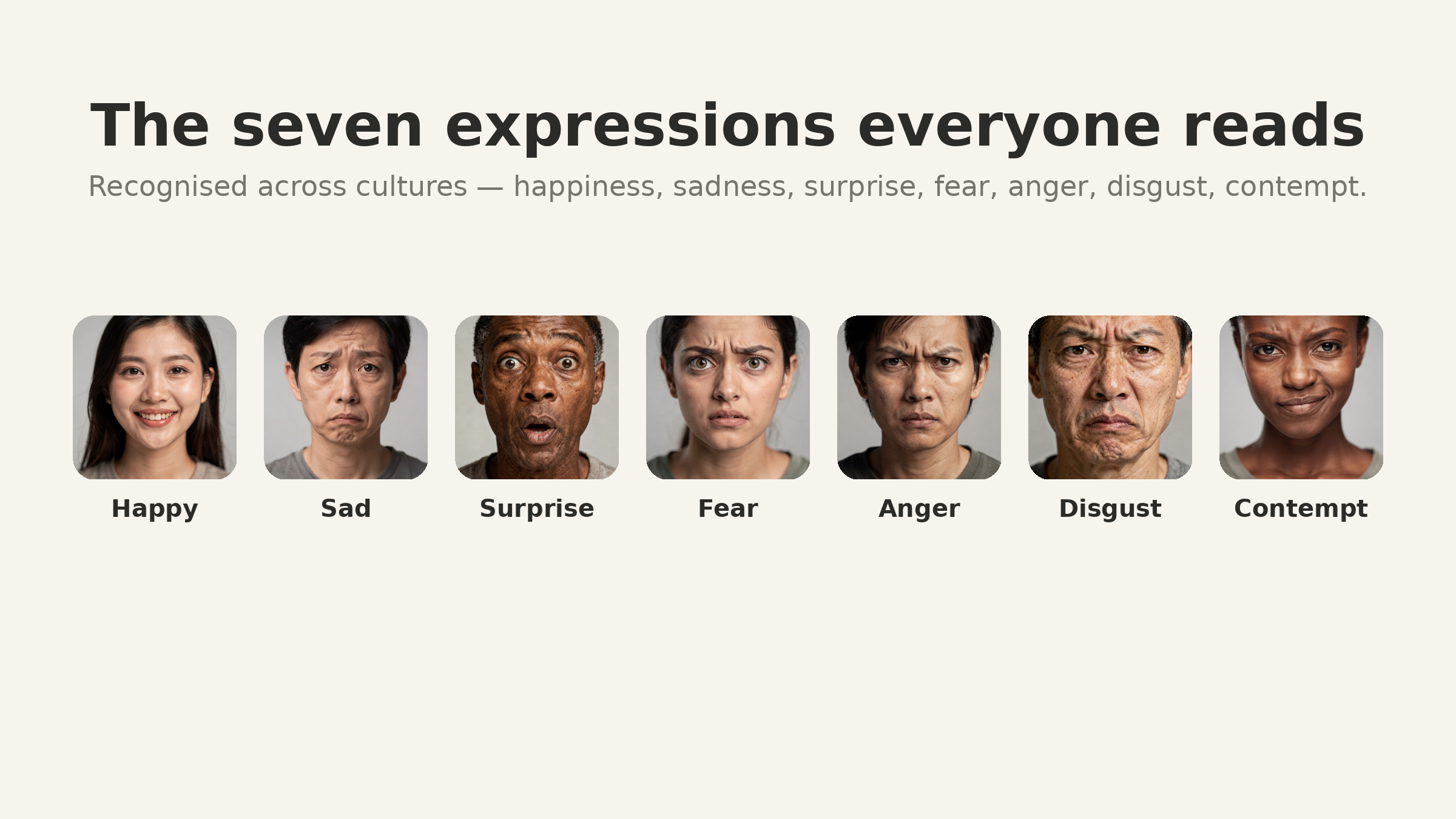
The faces that travel
In the late 1960s, Paul Ekman and colleagues showed photographs of facial expressions to people in literate cultures and, crucially, to the Fore people of Papua New Guinea, who had little contact with the outside world. People who had never seen Western faces still matched expressions of happiness, sadness, anger, fear, surprise, and disgust to short stories at rates well above chance.12
That result is the backbone of the idea that a handful of expressions are, to a large degree, universal — produced and recognized everywhere. Ekman later proposed contempt (a one-sided lip tightening) as a seventh, though its cross-cultural support is weaker and still debated.3
What a micro-expression actually is
The idea predates Ekman. In 1966, Haggard and Isaacs described fleeting "micromomentary" facial movements they spotted only when slowing down therapy films.4 A micro-expression is just a full expression that flashes briefly, often when someone is concealing or suppressing a feeling.
You will see "1/25th of a second" repeated everywhere as the magic duration. Treat that as folklore from the film-frame era rather than a measured constant. When researchers actually timed spontaneous leaked expressions, the defensible figure is under about half a second.5
The part that gets oversold
Myth Spotting a micro-expression lets you catch a liar.
What the research says In real, high-stakes interactions, true micro-expressions are rare and show up in honest and dishonest people alike. One well-known study found only about 2% of expressions qualified as genuine micro-expressions, and they did not cleanly separate liars from truth-tellers.6 Micro-expressions can hint that a feeling is being managed. They do not reveal why.
There is also a serious scientific challenge to the whole "read the emotion off the face" project. A 2019 review in Psychological Science in the Public Interest, led by Lisa Feldman Barrett, concluded that the same emotion is expressed by very different facial movements depending on person and context, and the same movements can mean different things. The authors specifically warn against using facial expressions to infer emotion in hiring, security, or AI systems.7
How to use this in real life
Read clusters, not single cues
One raised lip or furrowed brow proves little. Look for several signals lining up (face, posture, tone) before drawing any conclusion.
Anchor on the baseline
What does this particular person look like when relaxed? A change from their own normal is more informative than a textbook expression.
Let context vote
The "fear" face at a surprise party and the "fear" face in an argument mean different things. Situation is part of the read.
Check, don’t convict
Treat an expression as a question to ask ("You seem unsure — want to talk it through?"), not a verdict to act on silently.
Recognizing the expressions is a real, learnable skill, and a good starting point. Reading them accurately, under pressure, in context, is the harder one. That is exactly the part worth practicing. The free facial expressions test asks you to read a subtle expression from a single face with no story to lean on, and the eyes test narrows it to the eye region alone.
Now try reading a cue under a little pressure.
Short scenarios, instant feedback. Free to start, no sign-up.
Sources
- Ekman, P., Sorenson, E. R., & Friesen, W. V. (1969). Pan-cultural elements in facial displays of emotion. Science, 164(3875), 86–88. Link ↗
- Ekman, P., & Friesen, W. V. (1971). Constants across cultures in the face and emotion. Journal of Personality and Social Psychology, 17(2), 124–129. Link ↗
- Ekman, P., & Friesen, W. V. (1986). A new pan-cultural facial expression of emotion. Motivation and Emotion, 10(2), 159–168. Link ↗
- Haggard, E. A., & Isaacs, K. S. (1966). Micromomentary facial expressions as indicators of ego mechanisms in psychotherapy. In Methods of Research in Psychotherapy (pp. 154–165). Link ↗
- Yan, W.-J., Wu, Q., Liang, J., Chen, Y.-H., & Fu, X. (2013). How fast are the leaked facial expressions: The duration of micro-expressions. Journal of Nonverbal Behavior, 37(4), 217–230. Link ↗
- Porter, S., & ten Brinke, L. (2008). Reading between the lies: Identifying concealed and falsified emotions in universal facial expressions. Psychological Science, 19(5), 508–514. Link ↗
- Barrett, L. F., Adolphs, R., Marsella, S., Martinez, A. M., & Pollak, S. D. (2019). Emotional expressions reconsidered. Psychological Science in the Public Interest, 20(1), 1–68. Link ↗