Where Did “93% of Communication Is Body Language” Come From? (And Why It’s Wrong)
The famous 7–38–55 rule is one of the most-repeated statistics in communication. The studies behind it are real, but almost nobody quotes them correctly.
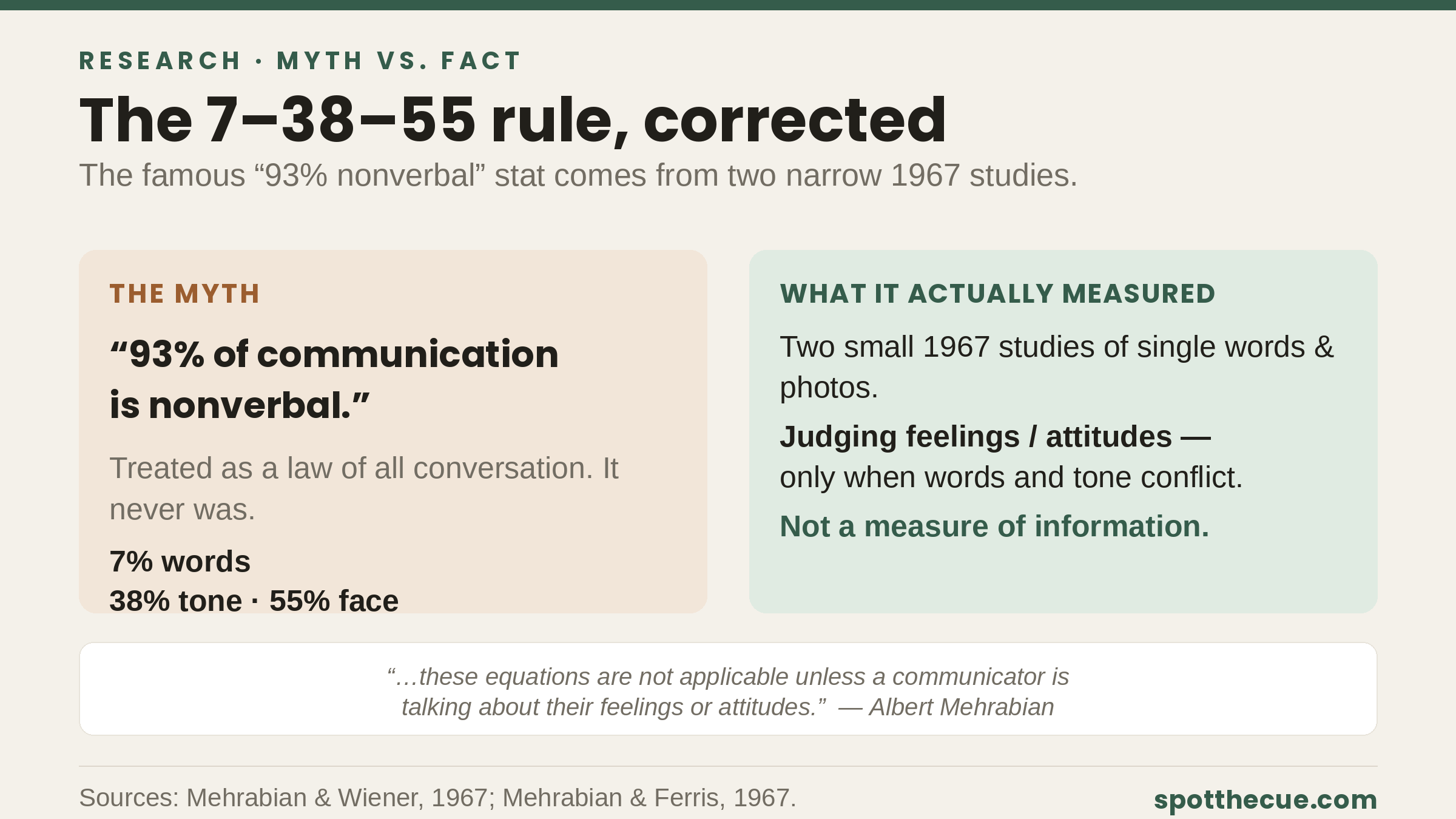
The claim you’ve heard
You have almost certainly heard it: words are only 7% of communication, tone is 38%, and body language is 55% — so "93% of communication is nonverbal." It appears in sales seminars, dating advice, and TED-style talks. It is also one of the most misused statistics in psychology.
What the studies actually did
The numbers trace to two small studies published by Albert Mehrabian and colleagues in 1967. In the first, two female speakers recorded nine single words: three warm ("dear", "thanks", "honey"), three neutral ("maybe", "oh", "really") and three harsh ("brute", "don’t", "terrible"), each spoken in a positive, neutral or negative tone. When the meaning of the word and the tone disagreed, listeners went with the tone.1 In the second, a single word ("maybe") was recorded in three tones by three female speakers and paired with black-and-white photographs of three female models’ facial expressions. The face outweighed the voice by roughly three to two.2
Mehrabian combined those two results into the now-famous 7–38–55 ratio. Read the fine print and the limits are obvious: every stimulus was a single spoken word, every speaker in both studies was female, and the judgments were about feelings and attitudes specifically in the artificial case where the verbal and nonverbal signals disagree.12
And here is the part the popular version gets most wrong. Neither study measured body language. No posture, no gesture, no movement, no eye contact — the first used voice recordings alone, the second used voice recordings and still photographs of faces. The 55% routinely quoted as "body language" was a photograph of a face. Whatever that ratio describes, it is not the thing people mean when they say most of communication is body language.12
Why the popular version is wrong
Myth “93% of communication is body language and tone.”
What the research says The studies never measured general communication or information transfer. If words were truly 7% of meaning, you could follow a lecture in a language you don’t speak by watching the speaker’s face. You can’t. The ratio only describes a narrow case: judging emotional attitude from mismatched cues.4
The part that’s genuinely useful
Strip away the bogus 93% and a real, practical insight remains: when someone’s words and their tone or face don’t match, people tend to trust the nonverbal channel. "I’m fine" said flatly, with a tight jaw, reads as not-fine. That read is usually right.
Watch for the mismatch
The signal isn’t "ignore words." It’s "notice when words and delivery point in different directions." That gap is where the real message often sits.
Don’t over-index on a single channel
Tone and face matter most for emotion and attitude. For facts, plans, and details, the words carry the load. Use the right channel for the job.
When in doubt, name it gently
If words and tone conflict, you can check: "You said yes, but you sound unsure — what would actually work better?"
Now try reading a cue under a little pressure.
Short scenarios, instant feedback. Free to start, no sign-up.
Sources
- Mehrabian, A., & Wiener, M. (1967). Decoding of inconsistent communications. Journal of Personality and Social Psychology, 6(1), 109–114. Link ↗
- Mehrabian, A., & Ferris, S. R. (1967). Inference of attitudes from nonverbal communication in two channels. Journal of Consulting Psychology, 31(3), 248–252. Link ↗
- Mehrabian, A. Silent Messages — author’s note on the 7%–38%–55% figures (archived). Link ↗
- Czerwinski, M. “The body language myth.” Psychology Today (2020). Link ↗