The Liking Gap: People Like You More Than You Think They Do
After a conversation, most of us quietly assume we came across worse than we did. The research says that assumption is systematically wrong, and it warps how we read other people’s cues.
Two scorecards, one conversation
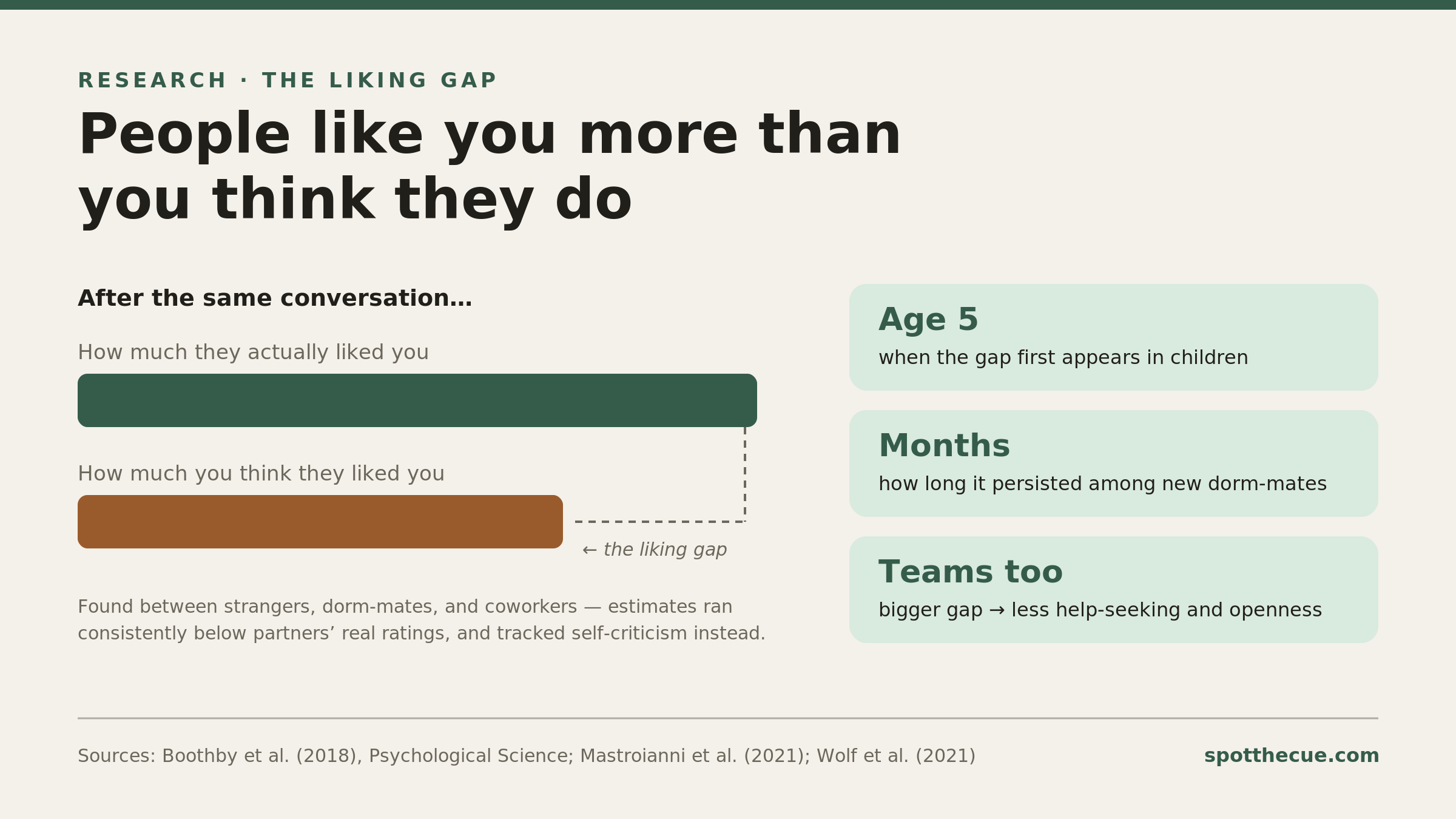
When two strangers finish a first conversation, each walks away with two scores: how much they liked the other person, and how much they think the other person liked them. In 2018, Erica Boothby, Gus Cooney, Gillian Sandstrom, and Margaret Clark compared those scores across a series of studies — lab pairs, first-year students getting to know their dorm-mates, strangers at a workshop. The result was remarkably consistent: people’s estimate of how much their partner liked them was reliably lower than how much the partner actually did. The researchers named this the liking gap.1
It isn’t a fleeting first-moments thing. The gap held for conversations lasting anywhere from a couple of minutes to three-quarters of an hour, and in the dorm study it persisted for months. New roommates and hallmates went most of an academic year underestimating how much the people around them enjoyed their company. Shyer people showed a larger gap, but the bias wasn’t limited to them.1
Why your read on yourself is off
The best-supported explanation is that after a conversation, you have privileged access to exactly one person’s inner monologue: your own. All the little self-critiques (that joke didn’t land, I talked too much, why did I say that) are loud and vivid to you and completely invisible to your partner. When the researchers looked at what drove people’s estimates, it was these self-critical thoughts; partners, meanwhile, were mostly just enjoying the conversation.1
Two older findings from Thomas Gilovich’s lab explain why the inner critic gets it so wrong. First, the spotlight effect: in the famous experiment, students made to wear an embarrassing Barry Manilow T-shirt estimated that roughly twice as many people had noticed it as actually had. We chronically overestimate how much others attend to our appearance and our slip-ups.2 Second, even when people do notice a blunder, they judge it far less harshly than the blunderer expects.3 Your worst moments are both less visible and less damning than they feel.
Myth If a conversation felt awkward to you, the other person probably came away not liking you.
What the research says How awkward a conversation felt from the inside is a poor predictor of how the other person rated it. In study after study, partners’ actual liking ran ahead of people’s guesses, and the guesses tracked people’s own self-criticism, not anything the partner reported noticing.1 Feeling awkward is information about your nerves, not their verdict.
It follows you into groups, teams, even childhood
The liking gap isn’t just a strangers-at-a-party effect. A 2021 follow-up found it in small group conversations and in engineering teams that had worked together on real projects, and it had teeth: the more team members underestimated how much colleagues liked them, the less willing they were to ask for help, speak openly, and work together again. The gap was largest between peers.4
It also starts young. Testing 4- to 12-year-olds, developmental researchers found the gap emerges around age five, right when children start caring about the impression they make, and widens with age.5 That timing supports the self-consciousness explanation: the gap grows alongside the worrying.
Recalibrating your reads
This matters for cue-reading because the liking gap is a calibration error: when the signal is about how someone feels about you, your decoder is biased toward the negative. A neutral expression becomes boredom; a short reply becomes rejection; a pause becomes judgment. Knowing the direction of the bias lets you correct for it.
Shift your prior
When a signal about you is ambiguous (a flat tone, a brief reply), the research says the truth is, on average, warmer than your gut estimate. Let "probably fine" be your default read, not "probably bad."
Score their behavior, not your replay
Judge how it went by what they did, not by re-running your own lines with the volume up. Did they ask follow-up questions, stay longer than they needed to, mention a next time?
Don’t flee the depth
People also overestimate how awkward deeper conversations will be; in experiments, deep exchanges with strangers felt less awkward and more connecting than predicted.6 The move that feels risky is usually the one that builds the liking.
Let reps do the correcting
A meta-analysis of stranger-conversation studies found people’s fears about being disliked and about lacking the skills were consistently overblown, and that pleasant practice conversations shrank those fears.7 Calibration improves with data.
The liking gap is oddly good news: the audience has been kinder than the review you’ve been writing about yourself. The skill worth practicing isn’t performing better. It’s reading the room as it actually is. That’s a calibration you can train, one low-stakes rep at a time, and it’s exactly what Spot the Cue is built for.
Now try reading a cue under a little pressure.
Short scenarios, instant feedback. Free to start, no sign-up.
Sources
- Boothby, E. J., Cooney, G., Sandstrom, G. M., & Clark, M. S. (2018). The liking gap in conversations: Do people like us more than we think? Psychological Science, 29(11), 1742–1756. Link ↗
- Gilovich, T., Medvec, V. H., & Savitsky, K. (2000). The spotlight effect in social judgment: An egocentric bias in estimates of the salience of one’s own actions and appearance. Journal of Personality and Social Psychology, 78(2), 211–222. Link ↗
- Savitsky, K., Epley, N., & Gilovich, T. (2001). Do others judge us as harshly as we think? Overestimating the impact of our failures, shortcomings, and mishaps. Journal of Personality and Social Psychology, 81(1), 44–56. Link ↗
- Mastroianni, A. M., Cooney, G., Boothby, E. J., & Reece, A. G. (2021). The liking gap in groups and teams. Organizational Behavior and Human Decision Processes, 162, 109–122. Link ↗
- Wolf, W., Nafe, A., & Tomasello, M. (2021). The development of the liking gap: Children older than 5 years think that partners evaluate them less positively than they evaluate their partners. Psychological Science, 32(5), 789–798. Link ↗
- Kardas, M., Kumar, A., & Epley, N. (2022). Overly shallow?: Miscalibrated expectations create a barrier to deeper conversation. Journal of Personality and Social Psychology, 122(3), 367–398. Link ↗
- Sandstrom, G. M., & Boothby, E. J. (2021). Why do people avoid talking to strangers? A mini meta-analysis of predicted fears and actual experiences talking to a stranger. Self and Identity, 20(1), 47–71. Link ↗