Where to Actually Practice Reading People: Books, Tests, and Tools Worth Your Time
A short field guide to resources for building social-perception skills: what’s free, what the evidence says, and what to be skeptical of.
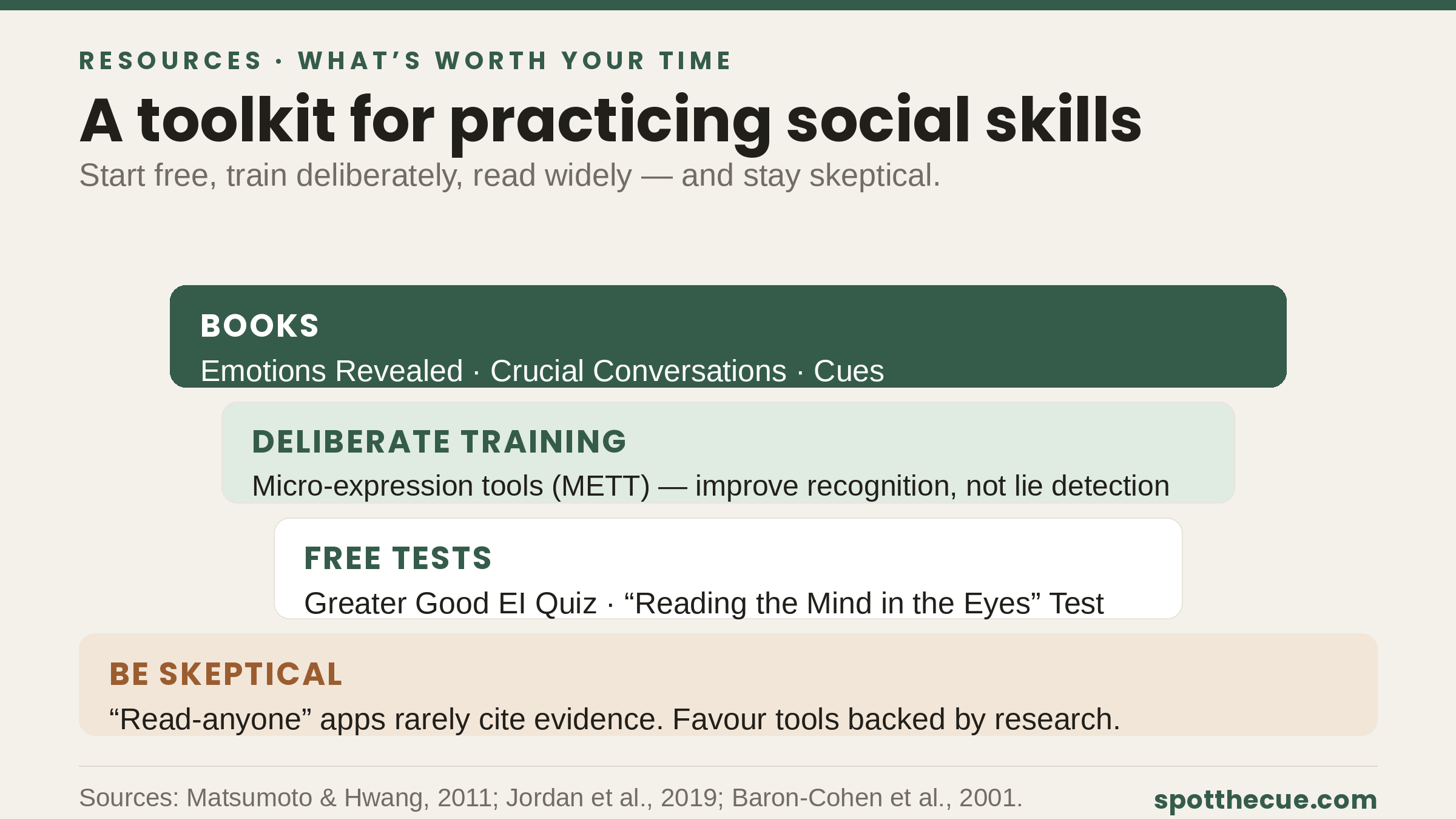
There’s no shortage of "decode anyone" content online, and most of it is confident and unsupported. Here’s a shorter list, organized from free to paid, with what the evidence actually says.
Start free: validated tests
Two free, research-grounded tests are a great calibration of where you’re starting from. The Greater Good Science Center at UC Berkeley hosts a short emotional-intelligence quiz built around reading expressions in photos.4 The "Reading the Mind in the Eyes" Test (RMET), developed by Simon Baron-Cohen and colleagues, asks you to infer mental states from the eye region alone and is widely used in research.3 Both are free and take only a few minutes.
Train deliberately: micro-expression tools
The Paul Ekman Group sells structured micro-expression and subtle-expression training tools (METT/SETT).5 Does that kind of training work? For recognition, yes: a controlled study found a brief training significantly improved people’s ability to spot micro-expressions, with gains holding up weeks later.1
Myth Micro-expression training makes you a human lie detector.
What the research says This is where to stay skeptical. Recognizing expressions in a lab is not the same as catching deception in the wild, and research testing this transfer has found weak real-world lie-detection benefits.2 Train to read emotion more accurately — not to "bust" people.
Read widely: books worth the time
- Emotions Revealed by Paul Ekman: a readable tour of the basic emotions and their facial signals, from the researcher most associated with them.
- Crucial Conversations by Patterson, Grenny, McMillan, Switzler & Gregory: practical structure for high-stakes, emotionally charged talks; strong on reading and managing the room.
- Cues by Vanessa Van Edwards: an accessible, example-rich popular guide to signals; enjoyable, though best read alongside the more cautious research above.
Be skeptical of: “read anyone” apps
We looked for consumer apps with solid published evidence for improving everyday social-cue reading and didn’t find much that’s independently verified. That doesn’t mean none help. It means you should treat big claims carefully. Favor tools that cite real research, acknowledge limits, and let you practice rather than promising to decode minds.
A simple plan
Take a free test to baseline → pick one skill (say, genuine vs. polite smiles) → practice it in short reps → read one good book to deepen the why. Repetition beats bingeing.
Now try reading a cue under a little pressure.
Short scenarios, instant feedback. Free to start, no sign-up.
Sources
- Matsumoto, D., & Hwang, H. S. (2011). Evidence for training the ability to read microexpressions of emotion. Motivation and Emotion, 35(2), 181–191. Link ↗
- Jordan, S., Brimbal, L., Wallace, D. B., Kassin, S. M., Hartwig, M., & Street, C. N. H. (2019). A test of the micro-expressions training tool. Journal of Investigative Psychology and Offender Profiling, 16(3), 222–235. Link ↗
- Baron-Cohen, S., Wheelwright, S., Hill, J., Raste, Y., & Plumb, I. (2001). The “Reading the Mind in the Eyes” Test Revised Version. Journal of Child Psychology and Psychiatry, 42(2), 241–251. (Take the test via the Autism Research Centre.) Link ↗
- Greater Good Science Center, UC Berkeley. Emotional Intelligence Quiz. Link ↗
- Paul Ekman Group. Micro Expressions Training Tools (METT/SETT). Link ↗