Five Body-Language Tips That Actually Hold Up in the Research
Most body-language advice is confident and unsupported. Here are five tips that survive a look at the evidence, caveats attached.
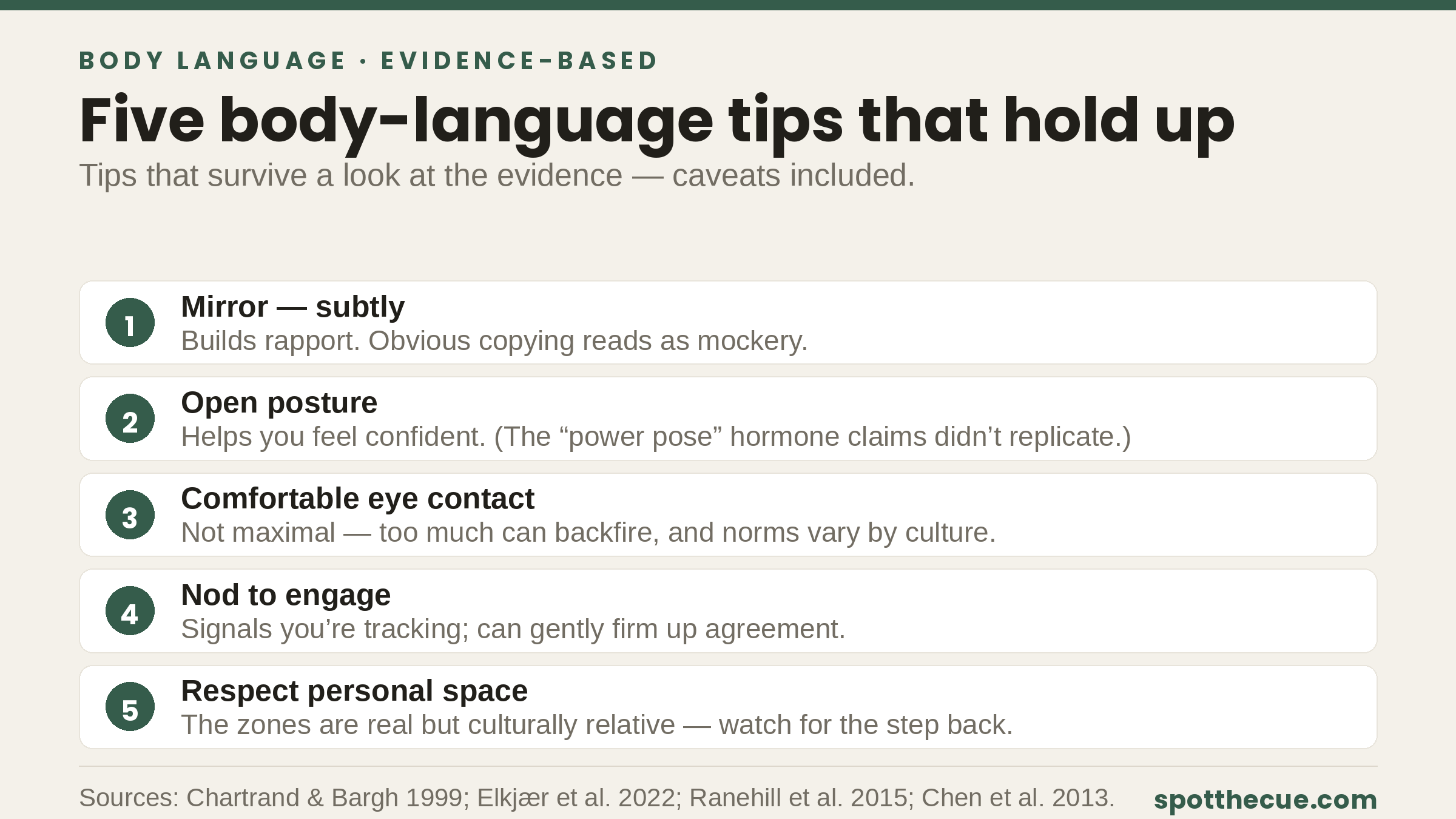
Body-language advice has a credibility problem: it is delivered with total confidence and rarely cites anything. Below are five tips that hold up reasonably well, each paired with the caveat the headlines usually skip.
1. Mirror, but subtly
People unconsciously copy each other’s postures, gestures, and mannerisms, and this "chameleon effect" tends to increase liking and smoothness between them. In the classic study, participants liked a partner more when that partner mimicked their mannerisms.1 The catch: it works when it’s subtle and natural. Obvious, deliberate copying reads as mockery.
2. Open up your posture (for yourself, not your hormones)
A meta-analysis of dozens of studies found that adopting an expansive, open posture has a small-to-moderate effect on how you feel — more positive, more confident.2 That part is real and useful before a nerve-wracking moment.
Myth Holding a “power pose” for two minutes changes your testosterone and cortisol and makes you take more risks.
What the research says The famous 2010 power-pose study3 did not hold up. A larger replication found the felt sense of power but no hormonal or risk-taking effects,4 and the original study’s first author later wrote that she no longer believes the effects are real. Use posture to shift your own mood, not as biochemistry.
3. Aim for comfortable eye contact, not maximal
More eye contact is not automatically better. In one study, more eye contact made people less open to persuasion when they already disagreed with the speaker.5 Eye-contact norms also vary across cultures, so the "right" amount is contextual. Aim for steady-but-relaxed, with natural breaks — roughly what a comfortable conversation feels like.
4. Nod to show you’re tracking
Nodding is a backchannel (a small signal that you’re following along), and it keeps a conversation flowing. Interestingly, your own head movements feed back on you: in one experiment, people who nodded (vs. shook their heads) while listening became more confident in the agreeable thoughts they were having.6 A genuine nod helps the speaker and can gently reinforce agreement.
5. Respect personal space, and know it’s cultural
Edward Hall’s classic model describes zones of personal space (intimate, personal, social, public) that people defend without thinking.7 But those distances are cultural norms, not universal laws; comfortable conversational distance differs markedly around the world. Watch for the small step back or lean-away that says you’ve crossed a line, and adjust.
The throughline
Every tip here is moderate and contextual. Treat body language as a way to reduce friction and signal warmth — not as a remote control for other people. If you want reps rather than rules, the body language practice works through real moments one at a time.
Now try reading a cue under a little pressure.
Short scenarios, instant feedback. Free to start, no sign-up.
Sources
- Chartrand, T. L., & Bargh, J. A. (1999). The chameleon effect: The perception–behavior link and social interaction. Journal of Personality and Social Psychology, 76(6), 893–910. Link ↗
- Elkjær, E., Mikkelsen, M. B., Michalak, J., Mennin, D. S., & O’Toole, M. S. (2022). Expansive and contractive postures and movement: A meta-analysis. Perspectives on Psychological Science, 17(1), 276–304. Link ↗
- Carney, D. R., Cuddy, A. J. C., & Yap, A. J. (2010). Power posing: Brief nonverbal displays affect neuroendocrine levels and risk tolerance. Psychological Science, 21(10), 1363–1368. Link ↗
- Ranehill, E., Dreber, A., Johannesson, M., Leiberg, S., Sul, S., & Weber, R. A. (2015). Assessing the robustness of power posing. Psychological Science, 26(5), 653–656. Link ↗
- Chen, F. S., Minson, J. A., Schöne, M., & Heinrichs, M. (2013). In the eye of the beholder: Eye contact increases resistance to persuasion. Psychological Science, 24(11), 2254–2261. Link ↗
- Briñol, P., & Petty, R. E. (2003). Overt head movements and persuasion: A self-validation analysis. Journal of Personality and Social Psychology, 84(6), 1123–1139. Link ↗
- Hall, E. T. (1966). The Hidden Dimension. Doubleday. Link ↗