The Follow-Up Question: The Small Conversational Habit That Makes People Like You More
Asking more questions makes people like you more — but only one kind of question does most of the work, and one popular kind quietly backfires. Here is what the research shows.
Does asking questions really make people like you more?
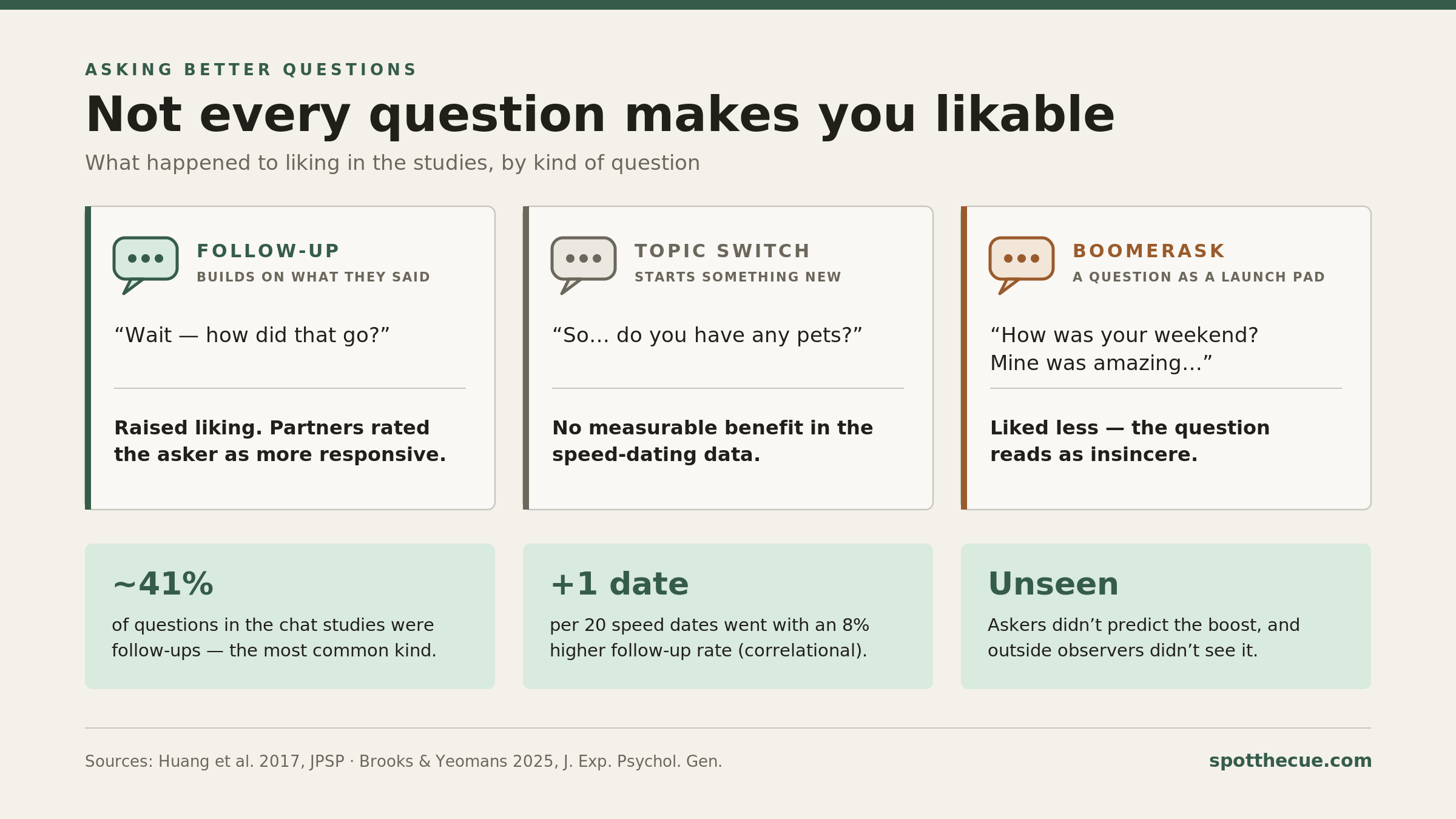
Yes, on the best evidence available — but with a specific shape that matters. In a set of studies from Harvard, people who asked more questions in a getting-to-know-you conversation were liked more by their partners, and the boost came mostly from follow-up questions: questions that invite the other person to say more about what they just said.1 The mechanism was responsiveness — the partner’s sense of being heard, understood and cared about. And a newer line of work shows the flip side: a question asked as a launch pad for talking about yourself tends to make people like you less.3
The study: questions in a 15-minute chat
Karen Huang, Michael Yeomans, Alison Wood Brooks, Julia Minson and Francesca Gino paired up strangers for 15-minute online chats. In the first experiment (199 pairs), one person in each pair was quietly instructed to ask either at least nine questions or at most four. Afterward, their partners rated how much they liked them. The high-question askers were liked significantly more.1 A second experiment, in which both partners were assigned a question condition, replicated the effect.1
The researchers then sorted every question by type. The biggest category, at about 41% of all questions, was the follow-up: “Oh, you’re learning guitar — what got you started?” Others switched to a fresh topic, mirrored a question back (“And you?”), or were routine openers. When they looked at which type was doing the work, it was the follow-ups. The share of follow-up questions predicted how responsive partners felt the asker was, and that in turn predicted liking.1
Then it held on real speed dates
Lab chats are one thing. The team also analysed recordings from a speed-dating event: 110 people, about 1,960 four-minute dates. People who asked a higher share of follow-up questions were more likely to get a “yes” for a second date. In the authors’ words, an 8% difference in follow-up question rates was associated, on average, with success on one additional date over an evening of 20.1 Other kinds of questions showed no such relationship.1
That speed-dating result is correlational — people who ask lots of follow-ups may differ in other ways, and the paper notes that question-asking looked like a fairly stable personal trait.1 It was later challenged by other researchers using a different statistical model; the original authors replied that the critique had tested the wrong outcome and that, analysed correctly, asking more questions still went with receiving more second-date offers.2 The experimental chat studies are where the causal evidence lives.
Nobody sees it coming — not even observers
The quietly striking part is how invisible this effect is. People told to ask lots of questions did not predict that their partner would like them more.1 And when the researchers showed the transcripts to 612 outside observers, those observers did not like the question-askers more either. If anything, they warmed to the people who were answering the questions.1
That fits the mechanism. A follow-up question is a gift to one specific person, the one whose story it picks up. From the outside it just looks like someone asking questions; from the inside it feels like being listened to. It also fits a broader finding: people find talking about themselves genuinely rewarding. In brain-imaging and behavioural studies, disclosing information about the self engaged reward-related brain regions, and in one study participants gave up roughly a quarter of the money they could have earned on certain trials in order to talk about themselves instead.4
Myth If you’re nervous in conversation, ask a quick question and then use it to share something interesting about yourself — that way you look curious and interesting.
What the research says This move has a name — boomerasking — and it tends to backfire. Alison Wood Brooks and Michael Yeomans found that more than 90% of people could recall being boomerasked, and a similar share could recall doing it themselves. Recipients rated those interactions as less enjoyable and more irritating than the boomeraskers themselves did. Across a series of experiments, someone who asked “How was your weekend?” only to launch into their own was seen as less sincere and liked less than someone who just shared the same news directly. In one dating scenario, willingness to go on a second date averaged about 56 out of 100 for the boomerasker versus about 71 for the person who simply shared.3 The cost was smaller when the other person had actually asked them first.3 The problem is not sharing. It is the question that was never really a question.
Why the fear of prying is mostly miscalibrated
A common reason people stop at surface questions is worry about seeming nosy. Two lines of research suggest that worry is usually overblown. In five experiments with 1,427 participants, Einav Hart, Eric VanEpps and Maurice Schweitzer found that people systematically overestimate the interpersonal cost of asking sensitive questions — and that people who were asked something sensitive, such as about their salary, rated the asker just as favourably as someone who asked an ordinary question.5
Similarly, across a dozen experiments, Michael Kardas, Amit Kumar and Nicholas Epley found that strangers expected deeper conversations to be more awkward and less enjoyable than they turned out to be, and underestimated how interested the other person would be in their more personal answers.6 None of this licenses interrogation. It does suggest that the question you are hesitating over is usually less risky than it feels.
How to use this
Pick up a detail, not a topic
The strongest question uses something they just said. “You mentioned your sister moved — how is she finding it?” beats “So, any siblings?” because it proves you were listening.
Ask “what” and “how,” then wait
Open questions (“What was that like?” “How did that happen?”) leave room to elaborate. Then give the answer its full space before you reply — the follow-up only works if you actually take in what comes back.
Answer, then hand it back
The research does not reward stonewalling. People want reciprocity, and the paper warns you can ask too many questions. When asked, give a real answer, then return the turn with a question about them.
Watch for your own boomerasks
If you notice you are asking a question mainly so you can tell your own story, just tell the story. “I have to tell you about my weekend” is more likable than pretending to ask about theirs.
Notice follow-ups coming your way
When someone asks you follow-ups, that is one of the clearer signs they are engaged. Fewer follow-ups is a weaker signal — some people are shy, tired or simply less practised — so don’t read too much into their absence.
If you’re anxious, let the question carry you
A follow-up turns your attention outward to what the other person is saying, which gives you something concrete to do instead of monitoring yourself.
The honest limits
A few things to hold loosely. The experimental evidence comes from short online chats between strangers on a research platform; the speed-dating evidence is observational. Neither tells you how this plays out in a long friendship, a tense meeting, or a negotiation, and the authors say plainly that questions probably work differently in competitive settings and that rude or badly timed questions would not help.1 The boomerasking studies leaned heavily on recalled experiences and written or video scenarios, with one study of natural conversations.3
One more piece of context, for transparency. Francesca Gino, a co-author of the original question-asking paper, later became the centre of a data-fabrication controversy over separate studies. Her co-authors have stated that she did not collect the data for any of the studies in this paper, and they have posted the full data and analysis code publicly while an independent audit of the paper is carried out.7 The later boomerasking work, by two of the original authors without Gino, uses entirely separate data and points in the same direction.3
What survives is a modest, practical conclusion. Questions are not a likability trick — they are a way of showing attention, and the kind that shows attention most clearly, the follow-up, is the kind that helps. If you want to practice catching the details worth following up on, our practice scenarios are a low-stakes place to try. It’s free to start and needs no sign-up.
Now try reading a cue under a little pressure.
Short scenarios, instant feedback — free to start, no sign-up.
Sources
- Huang, K., Yeomans, M., Brooks, A. W., Minson, J., & Gino, F. (2017). It doesn’t hurt to ask: Question-asking increases liking. Journal of Personality and Social Psychology, 113(3), 430–452. Link ↗
- Yeomans, M., Brooks, A. W., Huang, K., Minson, J., & Gino, F. (2019). It helps to ask: The cumulative benefits of asking follow-up questions. Journal of Personality and Social Psychology, 117(6), 1139–1144. Link ↗
- Brooks, A. W., & Yeomans, M. (2025). Boomerasking: Answering your own questions. Journal of Experimental Psychology: General, 154(1), 1–16. Link ↗
- Tamir, D. I., & Mitchell, J. P. (2012). Disclosing information about the self is intrinsically rewarding. Proceedings of the National Academy of Sciences, 109(21), 8038–8043. Link ↗
- Hart, E., VanEpps, E. M., & Schweitzer, M. E. (2021). The (better than expected) consequences of asking sensitive questions. Organizational Behavior and Human Decision Processes, 162, 136–154. Link ↗
- Kardas, M., Kumar, A., & Epley, N. (2022). Overly shallow?: Miscalibrated expectations create a barrier to deeper conversation. Journal of Personality and Social Psychology, 122(3), 367–398. Link ↗
- Many Co-Authors Project. (n.d.). Huang, Yeomans, Brooks, Minson & Gino (2017), “It doesn’t hurt to ask: Question-asking increases liking” — co-author statement on data collection and availability. Link ↗