Reading Tone in Text Messages: Why It Goes Wrong So Often
Senders are certain their meaning is obvious. Readers are close to guessing. Here is where the gap comes from, which text cues actually carry information, and the one move that closes it.
Why is tone so hard to read in a text message?
Because the channel strips out nearly everything that normally carries tone — timing, emphasis, pitch, face — and neither side notices the loss. The sender hears their own intended delivery while typing and assumes it travelled with the words. The reader supplies a delivery of their own and assumes it was the one sent. In a direct test of exactly this, sarcasm sent by email was decoded at a rate indistinguishable from chance, while the same statements read aloud were decoded about three-quarters of the time.1 The unsettling part is not the error rate. It is that confidence barely moved.
The gap between what you meant and what landed
Justin Kruger, Nicholas Epley, Jason Parker and Zhi-Wen Ng ran five experiments on this in 2005, and the design of the second is the cleanest. Pairs of participants each picked ten statements — half sarcastic, half serious — and sent them to a partner, either as email or as a voice recording. Senders predicted how many their partner would get right. Then the partners guessed.1
Voice listeners decoded nearly three-quarters of the statements. Email readers landed at a rate statistically indistinguishable from the 50% you would get by flipping a coin. But senders’ confidence did not differ between the two conditions at all — they were significantly overconfident on email and not overconfident at all on voice, purely because they failed to anticipate that the channel would cost them anything.1
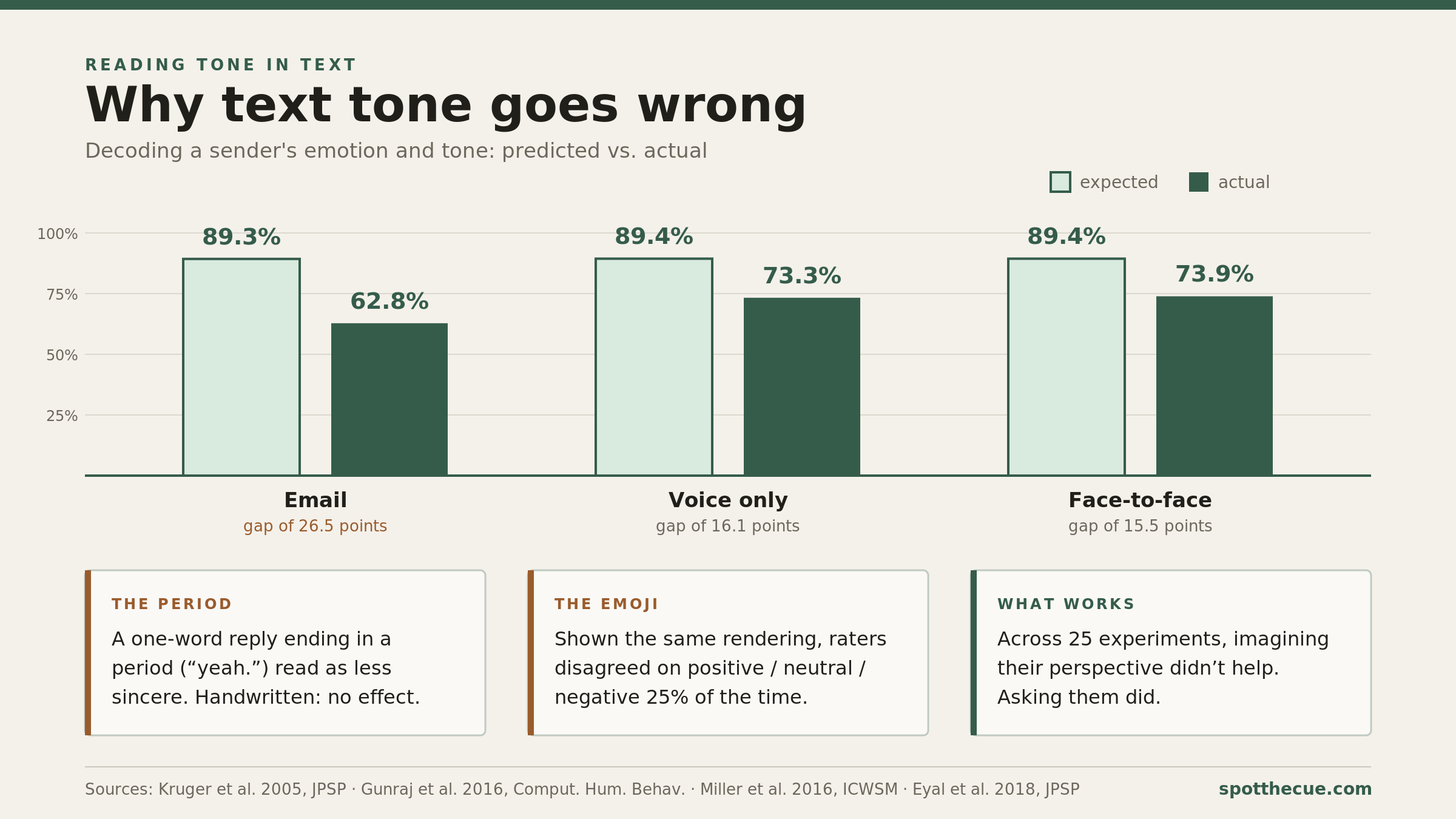
Their third study widened it beyond sarcasm to four tones — sarcasm, seriousness, anger and sadness — across email, voice-only and face-to-face. Receivers predicted they had understood about 89% of what was intended in every condition. Actual comprehension was 62.8% over email, 73.3% by voice alone and 73.9% face-to-face.1 Two things are worth sitting with there. Email is clearly the worst. And face-to-face — the gold standard, the one with the whole face attached — still only got to about three-quarters.
The receiving end has the same blind spot
It would be tidier if only senders were fooled. They are not. In that same email-versus-voice study, after readers guessed which statements were sarcastic, they were asked how well they thought they had done. Email readers said 89%. Voice readers said 91%. The two groups were equally confident — and only one of them was performing above chance.1
So the error compounds. A sender who believes their meaning is unmistakable writes to a reader who believes their interpretation is obviously correct. Neither has any reason to check. Most of what people call a "passive-aggressive text" is manufactured in that gap.
Myth A period at the end of a text means they’re annoyed with me.
What the research says Half true, and the half that is true is narrower than the folklore. Celia Klin’s team at Binghamton had 126 undergraduates read 16 exchanges in which someone made an invitation and the reply was a single affirmative word — "Okay," "Sure," "Yeah," "Yup" — either with a sentence-final period or with no punctuation at all. With the period, the reply was rated as less sincere. Crucially, when the identical exchanges were presented as handwritten notes rather than texts, the effect disappeared.2 A follow-up extended it: negative replies ("nope") and ambiguous ones ("maybe") also read as more negative or less enthusiastic with a period, and an exclamation mark pushed the other way, toward sincerity.3 So the period does carry information — but only as a rhetorical mark on a very short reply in a texting context.3 It is not a verdict on the person, it does not transfer to email or to longer messages, and the samples were young US undergraduates for whom that convention is strongest. Reading a period in your manager’s three-paragraph email as hostility is folklore, not findings.
Emoji help less than people assume
The obvious patch for missing tone is to add a marker — an emoji, a "lol," a "haha." It does help, and it is better than nothing. But it moves a message from ambiguous to less ambiguous, not to clear, because the marker is itself open to interpretation.
Myth Adding an emoji makes my tone unambiguous.
What the research says Researchers at the University of Minnesota surveyed people’s readings of the most popular emoji characters, each shown as it renders on different platforms. When two people rated the exact same rendering, they disagreed about whether its sentiment was positive, neutral or negative 25% of the time. Across renderings — your Apple grin arriving as someone else’s Android grimace — disagreement only increased.4 An emoji is a second ambiguous cue stacked on the first. Useful, but not a fix, and least reliable exactly where you need it most: the sarcastic, teasing, or half-serious message.
The fix is not a better-worded message
The intuitive repair is to try harder — reread it as they would, imagine how it lands, then send. There is a substantial body of work suggesting that step does not do what it promises. Tal Eyal, Mary Steffel and Nicholas Epley ran 25 experiments testing whether instructing people to take another person’s perspective improved their accuracy about that person — reading emotions from faces and postures, telling genuine smiles from fake, predicting a partner’s attitudes. Not one experiment found a benefit. If anything, perspective taking reduced accuracy slightly, while in places increasing confidence.5
What did work, in their framing, was perspective getting: actually obtaining the information rather than simulating it. That is a deflating conclusion for anyone hoping to become a better decoder by thinking harder, and a liberating one for anyone tired of trying. The move is not a cleverer read of the message. It is one more message: "Serious question or joking? Can’t tell from text."
The other repair is to stop typing. Amit Kumar and Nicholas Epley randomly assigned 200 people to reconnect with an old friend by email or by phone. Almost everyone predicted the call would be more awkward, and most preferred to email because of it. They were wrong: the call produced a significantly stronger bond and was not more awkward. When the researchers timed both, the call took about as long as reading and answering the email. A second study with strangers found the same thing — voice beat text for connection, with no awkwardness penalty.6
How to use this
Assume your tone did not send
You hear your own delivery as you type; the reader gets words on a screen. Before sending anything sarcastic, teasing or lightly critical, reread it flatly — no soundtrack. If it works flat, it will survive. If it needs your voice, it needs your voice.
Mark the tone explicitly, in words
Emoji are a second ambiguous cue, disagreed on a quarter of the time even within one rendering. "(joking)", "(genuine question)", "no sarcasm, I actually loved it" cost four words and remove the guess entirely.
Ask instead of decoding
Across 25 experiments, imagining someone’s perspective did not make people more accurate. Asking is the thing that works. "Read that as annoyed — was it?" is faster and more reliable than an hour of re-reading.
Do not convict on punctuation
The period effect is real but tiny in scope: a one-word reply, in a text, among people for whom that convention is live. It says nothing in an email, a long message, or from someone who simply types in full sentences.
Escalate to voice sooner than feels comfortable
The awkwardness you are avoiding is largely predicted, not experienced — and a call takes about as long as the email exchange it replaces. Three unproductive rounds of text is the signal to call.
When you are the anxious one, name the ambiguity
Interpretation bias makes a blank message read as a cold one. Rather than arguing yourself out of the feeling, treat the message as genuinely unreadable — because it is — and go get the missing information.
The honest limits
Several things to hold loosely. The Kruger studies are lab tasks with constructed statements and mostly student samples; the first study, using ten self-chosen topics between acquainted pairs, produced 84% accuracy rather than anything near chance — so channel loss is severe under hard conditions, not universal.1 The authors also flag a procedural wrinkle in the face-to-face comparison of their third study and decline to draw definitive conclusions about voice versus face-to-face overconfidence.1
The period work is a specific effect on short replies in one cultural and generational context, and the effect sizes are modest; it should not be extrapolated into a general theory of punctuation.23 The emoji study measures interpretation of emoji shown in isolation and with brief context, which is a harder test than an emoji arriving inside a real conversation — expect it to overstate real-world confusion somewhat.4 And Byron’s widely cited proposal that email is systematically read as more negative or more neutral than intended is a theoretical model, not an experimental finding, so treat it as a hypothesis with partial support rather than a settled fact.7
What survives is a fairly firm conclusion. Text strips out most of what carries tone, and the confidence on both ends does not adjust for the loss. The gap is not a character flaw or a sign of a bad relationship. It is a property of the channel, and it closes with one extra question rather than one more read-through.
Tone is one of the cues most worth practicing deliberately, precisely because the raw material is so thin and the pull toward the worst reading is so strong. Our practice sessions put you in exactly these moments — the flat reply, the message that could be a joke, the silence that could be anything. It’s free to start and needs no sign-up.
Now try reading a cue under a little pressure.
Short scenarios, instant feedback — free to start, no sign-up.
Sources
- Kruger, J., Epley, N., Parker, J., & Ng, Z.-W. (2005). Egocentrism over e-mail: Can we communicate as well as we think? Journal of Personality and Social Psychology, 89(6), 925–936. Link ↗
- Gunraj, D. N., Drumm-Hewitt, A. M., Dashow, E. M., Upadhyay, S. S. N., & Klin, C. M. (2016). Texting insincerely: The role of the period in text messaging. Computers in Human Behavior, 55, 1067–1075. Link ↗
- Houghton, K. J., Upadhyay, S. S. N., & Klin, C. M. (2018). Punctuation in text messages may convey abruptness. Period. Computers in Human Behavior, 80, 112–121. Link ↗
- Miller, H., Thebault-Spieker, J., Chang, S., Johnson, I., Terveen, L., & Hecht, B. (2016). “Blissfully happy” or “ready to fight”: Varying interpretations of emoji. Proceedings of the International AAAI Conference on Web and Social Media, 10(1), 259–268. Link ↗
- Eyal, T., Steffel, M., & Epley, N. (2018). Perspective mistaking: Accurately understanding the mind of another requires getting perspective, not taking perspective. Journal of Personality and Social Psychology, 114(4), 547–571. Link ↗
- Kumar, A., & Epley, N. (2021). It’s surprisingly nice to hear you: Misunderstanding the impact of communication media can lead to suboptimal choices of how to connect with others. Journal of Experimental Psychology: General, 150(3), 595–607. Link ↗
- Byron, K. (2008). Carrying too heavy a load? The communication and miscommunication of emotion by email. Academy of Management Review, 33(2), 309–327. Link ↗
- Chen, J., Short, M., & Kemps, E. (2020). Interpretation bias in social anxiety: A systematic review and meta-analysis. Journal of Affective Disorders, 276, 1119–1130. Link ↗