What Does a Long Pause Before Answering Mean?
The normal gap between turns is about a fifth of a second, which is why any hesitation feels enormous. Here is where a pause becomes real evidence — and where it becomes noise.
The short answer
A pause can mean someone is thinking, processing what you said, or deciding how to respond. Sometimes it accompanies reluctance, but silence alone cannot tell you which explanation fits — so consider the situation and their usual conversational rhythm, and ask when it matters.
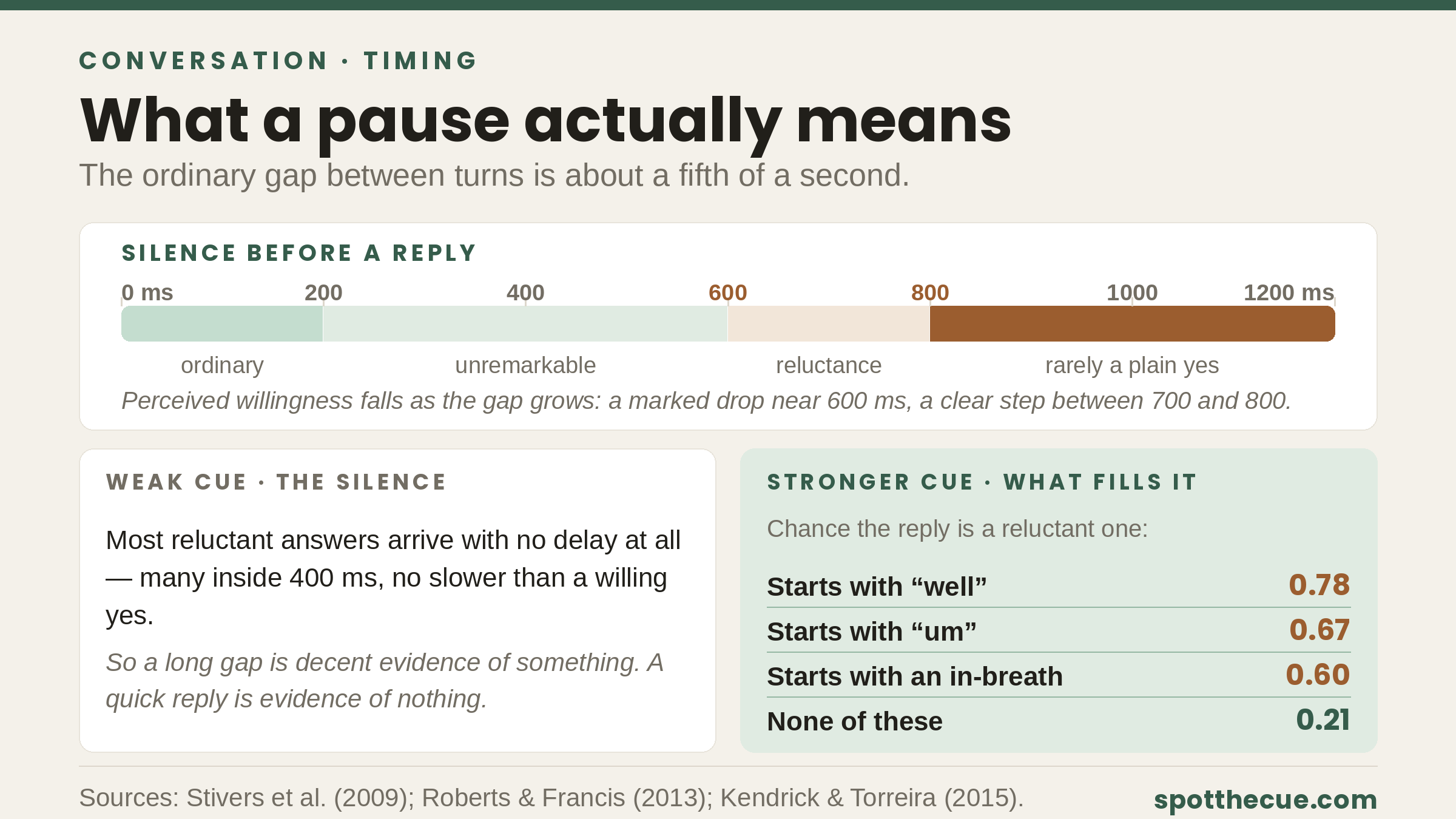
It usually means less than it feels like, and rarely the thing you fear. The ordinary gap between conversational turns is roughly 200 milliseconds — about the time it takes to say one syllable — so any hesitation registers as enormous from the inside.1 But when researchers actually measured where listeners begin to hear reluctance, the effect only becomes clear past about 600 ms, with a significant step between 700 and 800.2 And the inference only runs one direction: long gaps usually do precede a reluctant answer, while most reluctant answers arrive with no delay at all.3 The silence is weak evidence. What fills it — “well,” “um,” an audible in-breath — is much stronger.
The gap you are unconsciously measuring against
In 2009, Tanya Stivers and colleagues did something unusually ambitious: they timed question-and-answer sequences in informal, naturally occurring conversation across ten languages from five continents — Danish, Dutch, English, Italian, Japanese, Korean, Lao, Tzeltal and Yélî-Dnye. Every single language produced the same shape: a unimodal distribution with its peak between 0 and 200 ms, and an overall mode of exactly zero.1
The cross-language mean was +208 ms. That is a startling number, because psycholinguistic work suggests planning even a simple utterance takes at least 600 ms.3 The only way the arithmetic works is if your listener starts building their reply while you are still talking — predicting where your sentence is going and loading the answer before you finish it. Conversation is not a relay race with a clean handoff. It is two people running slightly overlapping legs.
Where a pause starts to read as reluctance
Felicia Roberts and Alexander Francis built a clean test of exactly this. They recorded dialogues in which someone made a request and the reply was always the same affirmative word — so any difference in how listeners judged it had to come from timing, not content. Then they varied the silence in front of that reply in 100 ms steps, from 200 ms all the way to 1200 ms, and asked 380 people how willing the responder sounded.2
Perceived willingness dropped steadily as the gap grew, with a notable fall-off around 600 ms and a statistically significant difference between the 700 and 800 ms conditions.2 An earlier study from the same group had found the same graded pattern across pauses of 0, 600, and 1200 ms, for both requests and assessments: more silence, less perceived willingness and weaker perceived agreement.4
So the effect is real, and — this is the useful part — it has a floor. A 300 ms hesitation sits inside the ordinary range, and listeners in these studies did not treat it as meaningful. If you are replaying a conversation and the evidence is "there was a beat before she answered," a beat is almost certainly all it was.
Myth A long pause means they don’t want to say yes. A quick answer means they do.
What the research says The first half is roughly right; the second half is wrong, and that asymmetry matters. Kendrick and Torreira timed 195 responses in recorded telephone conversations and found that reluctant responses were not systematically delayed — a large share of rejections arrived within 0–400 ms, no slower than acceptances. What they did find is that responses arriving very late, after about 700–800 ms, are “with very few exceptions” reluctant ones.3 Their summary is worth memorizing: long delays are not characteristic of reluctance, but reluctance is characteristic of long delays. A pause is decent evidence of something; the absence of a pause is evidence of nothing.
The cue is not the silence — it is what fills it
The same study found something more practical than any timing threshold. What actually separated reluctant responses from willing ones was not the length of the gap but the turn-initial material: the small stuff people put at the front of a reply before the reply itself starts.3
The numbers are unusually clean. When a response opened with the word “well,” the probability it was a reluctant one was 0.78. With a turn-initial “um,” 0.67. With an audible in-breath, 0.60. And when a response contained none of those — it just started — the probability dropped to 0.21.3 Nearly half of all reluctant responses began with an in-breath, against about 16% of willing ones.3
Fast responses do mean something — just not what you would guess
Timing is not meaningless. Emma Templeton and colleagues at Dartmouth had 66 people each hold ten conversations with different partners, then watch the video back and rate how connected they felt moment by moment. Faster response times tracked greater felt connection — both across conversations and within them, at the moment-to-moment level. The pattern held for close friends as well as strangers. In a third study, outside listeners heard the same clips with response times digitally sped up or slowed down, and judged the fast versions as more connected.5
The authors argue that because these differences operate on a timescale under 250 ms, they are below the reach of deliberate control — which is what makes them an honest signal rather than a performable one.5 Note what that implies: this is not advice to answer faster. A response you consciously hurry is not the thing the study measured. Fast responses are a readout of two people tracking each other, not a technique for producing that state.
Why some people are penalized for a gap they cannot close
Here is where cue-reading turns into fairness. That 200 ms baseline is a cross-language average, not a rule — and the spread is wide. Danish speakers averaged +469 ms between turns; Japanese speakers averaged +7 ms.1 Your instinct for "that took too long" is calibrated to whoever you grew up talking to, and it travels badly.
It travels badly within a language too. A 2025 study found that people with hearing loss begin their turns with longer and more variable delays than normal-hearing partners — and that third-party listeners, given nothing but the audio, rated those conversations as less natural, poorer in flow, and harder to follow.6 Nobody in that experiment was judging a person; they were judging a timing pattern produced by an ear. The same logic extends to anyone who processes language a beat slower: someone thinking in a second language, someone with an auditory processing difference, someone who is simply tired.
How to use this
Don’t read much into a short beat
The ordinary gap is around 200 ms, and in listener studies judgments of reluctance only shifted clearly past roughly 600. Those were constructed dialogues rather than your conversation, but the direction is clear: a short hesitation is weak evidence, and dropping those from your mental record removes most of what you have been over-reading.
Listen to the first sound, not the empty space
“Well,” “um,” and a sharp in-breath at the front of a reply were far better indicators than the length of the silence in one study of recorded phone calls — around 0.78, 0.67 and 0.60 probability of a reluctant response respectively, against 0.21 when a reply just began.
Never read a fast answer as reassurance
Most reluctant responses come quickly. If it matters whether someone actually wants to do the thing, speed tells you nothing and you have to ask: “Be honest — is that a real yes?”
Treat a long pause as a request, not a verdict
A gap past a second often means something is being managed — a qualification, a hesitation, or an indirect refusal or soft no. The move is to make it easy: “Take your time,” or “It’s completely fine if the answer’s no.” That converts a cue you can’t decode into a sentence you can.
Recalibrate for the person in front of you
Average gaps differ by hundreds of milliseconds across languages, and hearing loss, second-language processing and fatigue all stretch them. Compare someone against their own rhythm from earlier in the conversation, not against yours.
When you are the one pausing, say so
A silence is ambiguous; “Let me think about that for a second” is not. One short sentence removes the entire inference problem for the other person — and spares you the work of trying to look fast.
What to say next
When a pause matters, the useful move is usually to lower the cost of whatever answer is coming rather than to decode it. Before you choose, consider the wider social cues — their face, their words, what was just asked — and then try something like:
- “Take your time.”
- “Would it help if I clarified the question?”
- “It’s okay if that doesn’t work for you.”
The honest limits
A few things to hold loosely. The threshold studies used constructed dialogues judged by listeners rather than real conversations lived from the inside, which is what makes the timing manipulable but also what makes it artificial.24 The Kendrick and Torreira collection is 195 responses from telephone corpora — carefully measured, but a specific slice of talk, and largely invitations and requests rather than every kind of question.3 The Stivers data covers ten languages, which is a lot for this literature and still a thin sample of the world’s several thousand.1 And the connection findings are largely correlational within conversations, with only the observer study using a true manipulation.5
What survives all of that is a fairly firm shape. There is a real, measurable rhythm to turn-taking; departures from it do carry some information; that information is graded, one-directional, and much weaker than the feeling it produces. Most of what you have read into pauses was never in them.
This is a good cue to practice deliberately, because the raw material is so ambiguous and the pull toward the worst reading is so strong. Our practice sessions include exactly these moments — the beat before an answer, the reply that starts with “well,” the silence you are tempted to fill. It’s free to start and needs no sign-up.
Now try reading a cue under a little pressure.
Short scenarios, instant feedback. Free to start, no sign-up.
Sources
- Stivers, T., Enfield, N. J., Brown, P., Englert, C., Hayashi, M., Heinemann, T., Hoymann, G., Rossano, F., de Ruiter, J. P., Yoon, K.-E., & Levinson, S. C. (2009). Universals and cultural variation in turn-taking in conversation. Proceedings of the National Academy of Sciences, 106(26), 10587–10592. Link ↗
- Roberts, F., & Francis, A. L. (2013). Identifying a temporal threshold of tolerance for silent gaps after requests. The Journal of the Acoustical Society of America, 133(6), EL471–EL477. Link ↗
- Kendrick, K. H., & Torreira, F. (2015). The timing and construction of preference: A quantitative study. Discourse Processes, 52(4), 255–289. Link ↗
- Roberts, F., Francis, A. L., & Morgan, M. (2006). The interaction of inter-turn silence with prosodic cues in listener perceptions of “trouble” in conversation. Speech Communication, 48(9), 1079–1093. Link ↗
- Templeton, E. M., Chang, L. J., Reynolds, E. A., Cone LeBeaumont, M. D., & Wheatley, T. (2022). Fast response times signal social connection in conversation. Proceedings of the National Academy of Sciences, 119(4), e2116915119. Link ↗
- Petersen, E. B. (2025). Hearing-loss related variations in turn-taking time affect how conversations are perceived. PLOS ONE, 20(6), e0325244. Link ↗
- Koudenburg, N., Postmes, T., & Gordijn, E. H. (2011). Disrupting the flow: How brief silences in group conversations affect social needs. Journal of Experimental Social Psychology, 47(2), 512–515. Link ↗
- Chen, J., Short, M., & Kemps, E. (2020). Interpretation bias in social anxiety: A systematic review and meta-analysis. Journal of Affective Disorders, 276, 1119–1130. Link ↗