A body language app for reading people, not memorizing rules
Most body-language advice is confident and wrong. This is practice instead of trivia: short, realistic moments where you read the posture, the gesture, the distance — and find out right away what the cue actually supports. Nothing to install, nothing to sign up for.
Try three reads
Moments from the practice bank, at the level everyone gets free. Pick the read you think fits. The explanation is underneath either way. Images and clips are AI-generated and labelled as such; the people in them aren’t real.
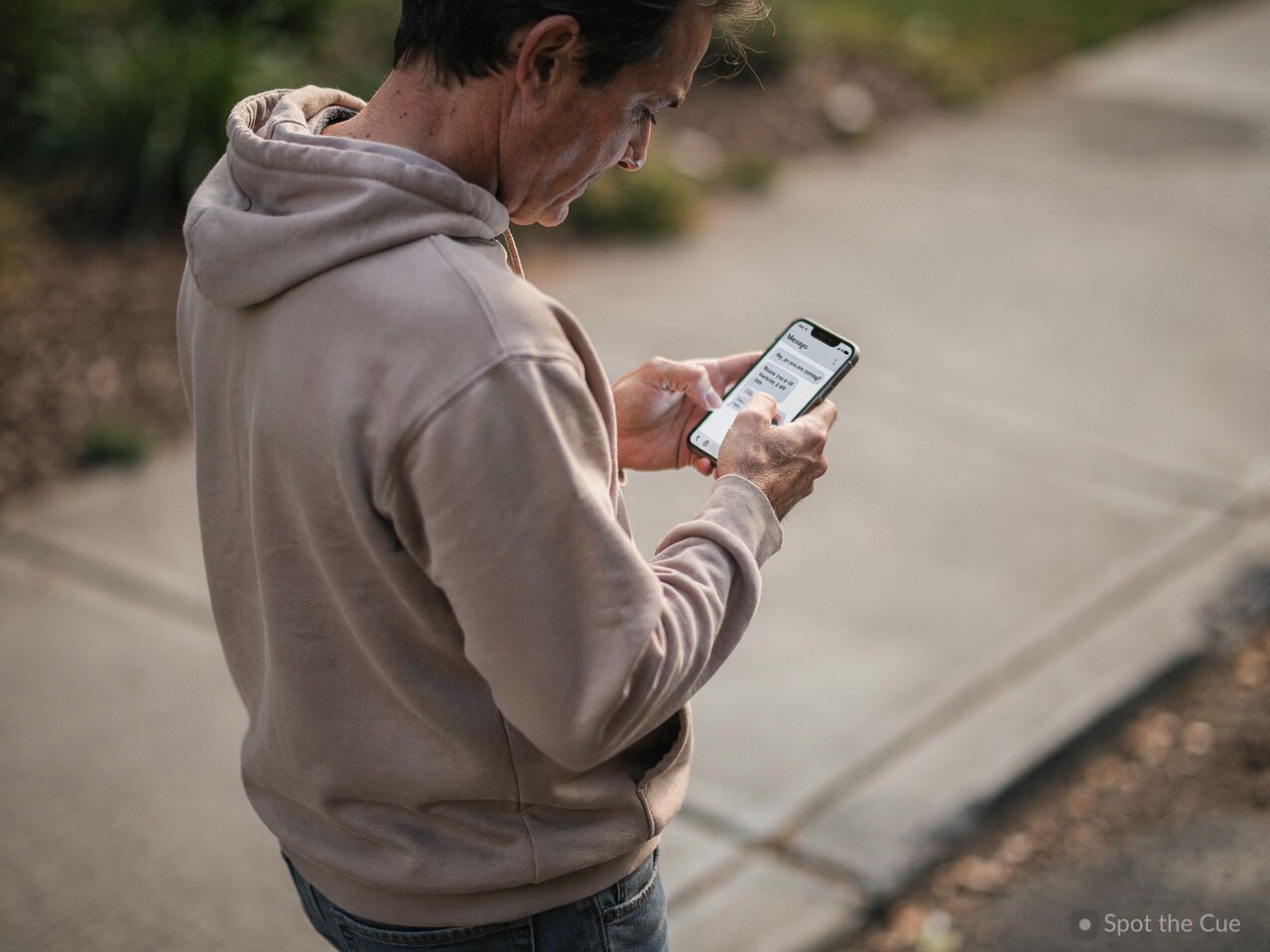
You walk up to a friend to start chatting. They’re on their phone.
They keep their eyes on the screen, body angled away, and answer you with a distracted “mm-hm.”
What’s the cue telling you?
Best read They’re absorbed elsewhere and not really available now.
Eyes down, body turned, and a distracted “mm-hm” mean their attention is captured, not that they’re snubbing you. Best move is to wait or flag it lightly: “Catch you when you’re done?” rather than launching into something important now.

You’re a few minutes into chatting with someone who’s waiting to be somewhere.
They keep glancing down at their watch, shifting their weight, and giving shorter answers.
What’s the cue telling you?
Best read They’re pressed for time and need to move on.
Repeated watch-checks, weight-shifting, and shrinking replies signal time pressure, not rudeness. Name it and free them: “I can tell you’ve got to run — let’s pick this up later.”

You wrap up a first meeting with a potential collaborator.
They offer a firm handshake, hold eye contact, smile, and lean in slightly: “Really glad we did this.”
What’s the read?
Best read Genuine warmth: the meeting went well.
A firm handshake with eye contact, a real smile, and a slight lean-in is a cluster of genuine goodwill. Safe to assume the rapport is real and build on it. Note that this one is a positive read — a practice bank where every answer is “something is being hidden” would just train suspicion.
That’s three of more than ninety face-and-body moments in the adult bank. Over eighty percent of them are built on a photo or a short clip rather than a written description of a gesture, which would already contain the answer. Open the app to keep going
Want a score? The 12-question test grades what you catch and what you over-read, with an explanation for every moment.
Take the free body language testWhat body language can and can’t tell you
The reason most body-language content doesn’t help is that it’s built on claims the research doesn’t support. Here’s what we correct, and why.
Myth “93% of communication is body language and tone.”
What the research says The 7–38–55 figure comes from two small 1967 studies about judging someone’s feelings when their words and tone conflict.1 It was never a measure of how much information words carry in ordinary conversation. If it were, you could follow a lecture in a language you don’t speak by watching the speaker. Mehrabian spent decades asking people to stop citing it that way. The full story of where the number came from →
Myth “Crossed arms mean they’re closed off.”
What the research says Single gestures are close to meaningless on their own. Arms cross because a room is cold, because a chair has no armrests, because someone is thinking, and sometimes because they’ve pulled back from you. What carries information is a cluster that shifts together (posture, orientation, distance, face and voice moving in the same direction at the same moment), read against how that person normally sits. Every scenario here is built as a cluster in a situation, never a gesture on a card.
Myth “You can spot a liar from their body language.”
What the research says The largest meta-analysis of deception judgments (206 studies, 24,483 judges) puts average accuracy at 54%, against 50% for a coin flip.2 A 2019 test of the micro-expressions training tool found trained participants did no better than untrained ones, with overall accuracy slightly below chance.3 Apps that promise lie detection are selling something that doesn’t exist, and the cost of believing them is landing on innocent people. What actually helps instead →
Myth “Reading people is a knack — you either have it or you don’t.”
What the research says This is the one place the evidence is encouraging. Person-perception accuracy is measurable, it varies between people, and a meta-analysis of training studies found it improves with training that gives immediate, explained feedback.4 That specific, narrow claim is the one this app is built on. The research behind the app →
What you practice
Body language isn’t a separate skill from the rest of reading a room, so it isn’t a separate app. It’s one track among several, plus two paths that focus on it directly.
Body language path
Posture, gestures, fidgeting and personal space — all from photos and video rather than written descriptions, because a description of a gesture already contains the answer.
Reading faces path
Smiles, eyebrows, gaze, and the difference between a real smile and a polite one. Includes deliberate controls (faces where nothing is being covered) so you don’t learn to see masking everywhere.
Name that expression
A fast drill on the core expressions most people recognize across cultures, one quick read at a time. Good for warming up before a longer session.
The channels around it
Vocal tone, subtext, group dynamics, conflict, and pressure. Body language on its own is the least reliable channel you have, and reading it in isolation is how people go wrong.
How it works
- See a real moment. A photo or short clip with the situation around it: who these people are to each other, what just happened.
- Choose your read. Four options. They’re not one right and three stupid: near-miss reads are common and deliberate.
- Get scored in three tiers. Best read, reasonable read, or misread. A thoughtful answer that isn’t the strongest still earns credit, because real cues are rarely binary and a scoring system that pretends otherwise teaches overconfidence.
- Read why. A plain explanation of which signals carried the weight, what would have changed the read, and often what to actually say next.
Questions people ask
Is there an app for reading body language?
There are several, and most of them are dictionaries — lists that tell you crossed arms mean defensiveness and touching your nose means lying. Spot the Cue is built the other way round: instead of memorizing a glossary, you read real moments one at a time and get an explanation of what the cue actually supports. It runs in any browser and there’s an iPhone app too. Level 1 of every track is free and scored, with no sign-up.
Can an app really teach you to read body language?
Up to a point, and the point matters. Person-perception accuracy (how well you read emotion and intent from faces and bodies) does improve with training that gives immediate, explained feedback. That’s the finding a meta-analysis of training studies reports.4 What an app can’t do is turn you into a human lie detector, because that ability doesn’t reliably exist in anyone. Treat it as calibration practice, not a superpower.
What’s the best way to practice reading body language?
Short, frequent reps on real moments, with feedback straight after each one, and deliberate exposure to cases where the best read is “nothing much is going on here.” Reading lists of gestures doesn’t transfer, because real cues arrive in clusters and in context. It also helps to practice moments where you’re wrong — the correction is where the learning is.
Is it true that 93% of communication is body language?
No. That figure comes from two small 1967 studies about judging someone’s feelings when their words and their tone conflict.1 It was never a measure of how much information words carry in ordinary conversation, and Mehrabian himself spent decades asking people to stop citing it that way. The useful kernel is narrower: when words and tone clash, people tend to believe the tone. The long version →
Can you tell if someone is lying from their body language?
Not reliably. The largest meta-analysis of deception judgments (206 studies and 24,483 judges) found people average 54% accuracy, against 50% for a coin flip.2 A 2019 test of the micro-expressions training tool found trained participants did no better than untrained ones.3 Any app promising you can spot liars is selling something the evidence doesn’t support, which is why this one doesn’t.
Does this work for autistic adults or people with social anxiety?
It’s built with them in mind. Explanations are literal rather than knowing, near-miss answers get partial credit instead of being marked wrong, and the app is careful not to imply that other people’s meaning is obvious and you’re simply missing it. It’s general practice, not a clinical or diagnostic tool, and not a substitute for professional support.
Is the body language app free, and is there an iPhone version?
Level 1 of every track, including body language, is free and fully scored in the browser, with no sign-up and no ads. Levels 2 to 6 are part of the paid unlock; the pricing page has the detail. There’s an iPhone app on the App Store, and the practice bank is the same on both.
What’s the difference between body language and social cues?
Body language is one channel of social cues: posture, gesture, distance, orientation, and what the face is doing. Social cues also include vocal tone, word choice and subtext, timing and silence, and how a group’s attention moves. Body language is rarely readable on its own. The same folded arms mean different things in a cold room and a tense meeting, which is why practice here covers the other channels too. The cue glossary defines the ones that come up most.
Reading people is a skill, and skills grow with reps.
Start with the free level of the body
language track. No sign-up, no ads.
Sources
- Mehrabian, A., & Wiener, M. (1967). Decoding of inconsistent communications. Journal of Personality and Social Psychology, 6(1), 109–114. Link ↗
- Bond, C. F., Jr., & DePaulo, B. M. (2006). Accuracy of deception judgments. Personality and Social Psychology Review, 10(3), 214–234. Link ↗
- Jordan, S., Brimbal, L., Wallace, D. B., Kassin, S. M., Hartwig, M., & Street, C. N. H. (2019). A test of the micro-expressions training tool: Does it improve lie detection? Journal of Investigative Psychology and Offender Profiling, 16(3), 222–235. Link ↗
- Blanch-Hartigan, D., Andrzejewski, S. A., & Hill, K. M. (2012). The effectiveness of training to improve person perception accuracy: A meta-analysis. Basic and Applied Social Psychology, 34(6), 483–498. Link ↗
Related: the body language test · the other free tests · the seven expressions, and the micro-expressions people miss · a real smile vs. a polite one · five body-language tips that hold up · how to read the room · the cue glossary.