How Much Eye Contact Is Normal? What Eye-Tracking Studies Actually Show
Popular advice says to hold eye contact most of the time. When researchers actually measure it, real eye contact turns out to be brief, frequent, and far rarer than it feels.
Why eye contact advice feels so stressful
If you’ve ever been mid-conversation and suddenly wondered “am I looking at them too much? Too little? Which eye?”, you’re not alone. Eye contact is one of the most-taught social skills and one of the least-measured in everyday advice. The good news is that researchers have now put eye-trackers on both people in real conversations, and what they found is a lot more forgiving than the usual rules.
What happens in a real conversation
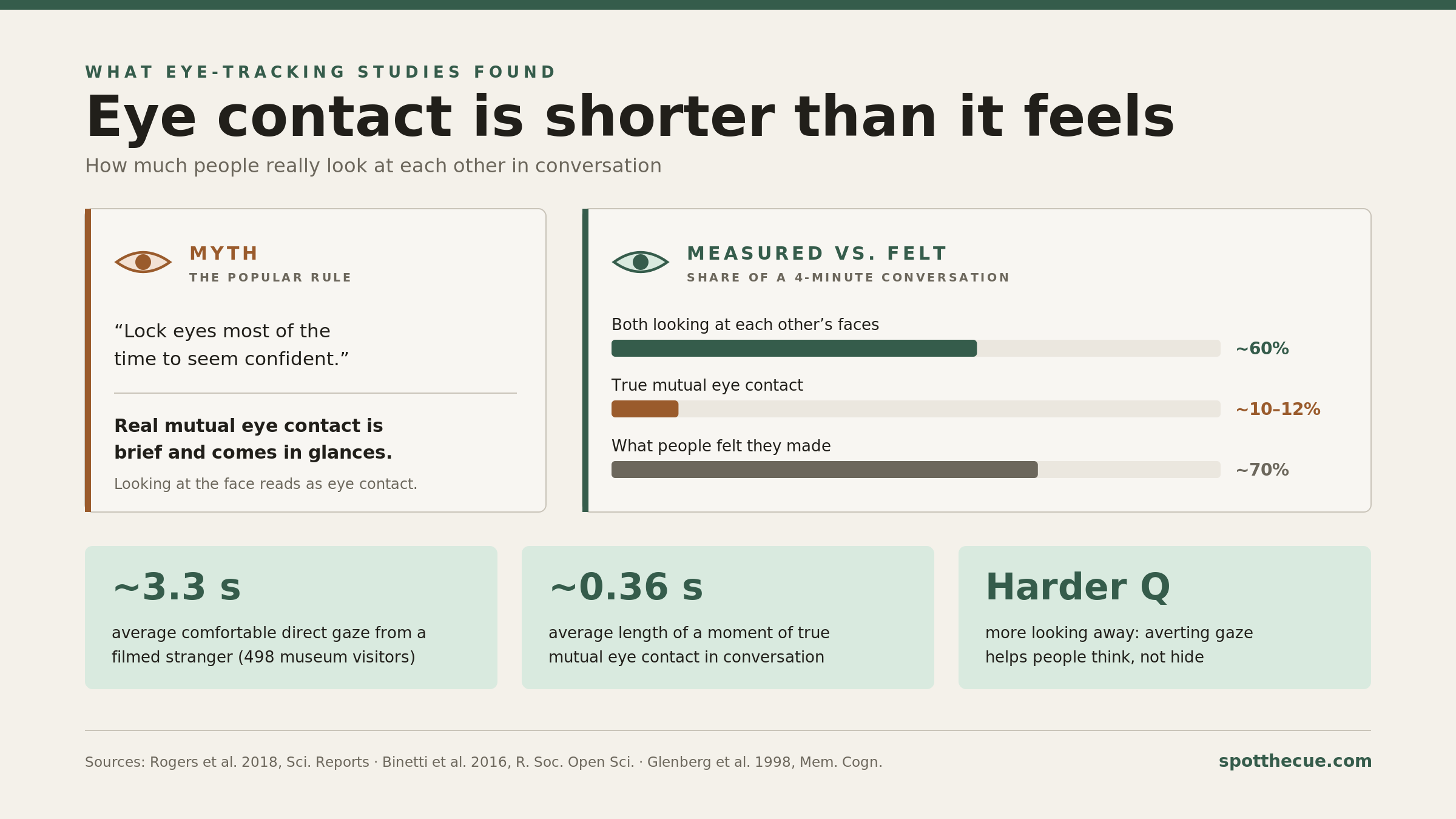
Shane Rogers and colleagues fitted pairs of previously unacquainted people with eye-tracking glasses and recorded four-minute getting-acquainted conversations. Gaze on the face dominated both speaking and listening. Partners looked at each other’s faces at the same moment for about 60% of the conversation, in stretches averaging around 2 seconds. But mutual eye contact, both people looking at each other’s eyes at once, was much rarer: roughly 10–12% of the conversation on average, in episodes averaging about 0.36 seconds.1
Here is the striking part. Asked afterwards, the same people estimated they had made eye contact about 70% of the time.1 What feels like steady eye contact is mostly people looking at each other’s faces, eyes and mouth included, with brief overlaps of true eye-to-eye contact.
Myth Good communicators lock eyes and hold them. Aim to keep eye contact most of the time.
What the research says Precise-sounding rules like “hold eye contact 60–70% of the time” are usually repeated without a source. When researchers measured real conversations, true mutual eye contact took up only about a tenth of the time and came in fractions of a second, yet people experienced it as constant.1 Looking at someone’s face in general, with natural glances to the eyes, reads as eye contact.
The same study found big, stable individual differences. Some people mostly looked at their partner’s eyes, some mostly at the mouth, and many split their gaze, and each person’s pattern stayed consistent whether they were talking or listening.1 There is not one correct way to look at a face.
How long is a comfortable gaze?
Nicola Binetti and colleagues tested 498 visitors to London’s Science Museum. Each watched video clips of an actor looking straight at them for different lengths of time and said whether each gaze felt too short or too long. The average preferred duration was about 3.3 seconds, give or take around 0.7 seconds. That preference wasn’t explained by the viewer’s gender, personality traits, or how attractive they found the actor.2
Two caveats matter. Participants were imagining a silent encounter with a stranger, and they were watching a video, not talking to a live person; the authors note this one-way setup doesn’t capture a real two-way exchange.2 So “about three seconds” is a sensible ceiling for a single unbroken stare at a stranger, not a stopwatch target for conversation.
Breaking eye contact is part of the rhythm
Looking away isn’t a failure of eye contact. It seems to be built into how conversation works. In a study of 93 pairs of college students, Sophie Wohltjen and Thalia Wheatley tracked how closely the partners’ pupil sizes rose and fell together, a measure linked to shared attention. Eye contact tended to start as this synchrony peaked and to break as it bottomed out. Pairs also rated the conversation as more engaging during moments of eye contact.3 The authors suggest, cautiously, that eye contact may signal “we’re in sync,” and that breaking it may give each person room to think their own thoughts.3
Gaze also helps manage turn-taking. A classic proposal by Adam Kendon, summarised in a 2021 systematic review, is that speakers often look away as they begin a turn and look back toward the listener as they finish, as if to say “your turn.” The review found reasonable support for gaze helping speakers hand over the floor, but less consistent evidence for other parts of the pattern.4
Looking away often means “I’m thinking”
People are more likely to avert their gaze when they’re trying to answer harder questions, and closing the eyes has been found to help recall.5 In a study of 36 eight-year-olds, children looked away more for difficult questions and more when questioned face to face than over a video link. The authors concluded that the main job of looking away is to manage cognitive load: a face is a lot of information to process while you’re also trying to think.6
That is worth remembering in both directions. When someone glances away before answering, they are probably working something out, not dodging you. And if you find yourself looking away to gather your thoughts, that’s normal, not rude.
More isn’t always better, and norms vary
Eye contact doesn’t automatically make people warmer toward you. In one set of experiments, listeners who already disagreed with a speaker were less persuaded the more time they spent looking at the speaker’s eyes.9 Intense eye contact can feel like pressure, especially during disagreement.
Culture matters too. When Hironori Akechi and colleagues showed live faces to Finnish and Japanese university students, Japanese participants were more likely to see a face making eye contact as angrier, less approachable, and more unpleasant.7 The study compared only two countries, so it is an illustration that norms differ, not a map of them.
And for many autistic people, eye contact isn’t just a social choice. In an analysis of hundreds of first-hand online accounts from people who described themselves as autistic, common themes included anxiety and physical discomfort, a feeling of intrusion, and sensory overload that made it harder to listen. Many described strategies like looking at the mouth or just near the eyes.8 Reduced eye contact is not a reliable sign that someone isn’t paying attention.
Putting it into practice
Look at the face, not into the eyes
Resting your gaze on the general area of someone’s face, with natural glances to the eyes and mouth, is what most people do and what reads as eye contact.1
Think in glances, not stares
True mutual eye contact tends to come in short moments.1 If a single unbroken gaze at a stranger is stretching well past a few seconds, a natural break is fine.2
Look more while listening
People look away from the face more while speaking than while listening.1 If you want to signal attention, the listening part of the conversation is where steady gaze matters most.
Let yourself look away to think
Glancing away while you work out an answer is a normal way to manage mental load.6 It isn’t evasive.
Don’t read gaze as a lie detector
Someone looking away may be thinking, managing discomfort, following a cultural norm, or simply wired differently. Look for the bigger pattern: are they engaged, responsive, and following the thread?
Ease off in disagreement
If a conversation is tense, intense eye contact can backfire.9 Softer, more intermittent gaze can lower the pressure.
Where the evidence runs out
Eye-contact research is harder than it looks. Studies differ in what they count as eye contact and how they measure it.10 The best real-conversation data come from small samples of strangers talking briefly.1 The 3.3-second figure comes from watching videos, not live conversation.2 And the cross-cultural evidence here covers only a couple of countries.7 What holds up across all of it is the general shape: comfortable eye contact is intermittent, it varies a lot between people, and looking away is a normal part of talking.
If eye contact is something you overthink, the most useful shift may be to stop counting seconds and start noticing whether the conversation is flowing. Our body language practice is a low-pressure place to get reps reading cues like these in context.
Now try reading a cue under a little pressure.
Short scenarios, instant feedback. Free to start, no sign-up.
Sources
- Rogers, S. L., Speelman, C. P., Guidetti, O., & Longmuir, M. (2018). Using dual eye tracking to uncover personal gaze patterns during social interaction. Scientific Reports, 8, 4271. Link ↗
- Binetti, N., Harrison, C., Coutrot, A., Johnston, A., & Mareschal, I. (2016). Pupil dilation as an index of preferred mutual gaze duration. Royal Society Open Science, 3(7), 160086. Link ↗
- Wohltjen, S., & Wheatley, T. (2021). Eye contact marks the rise and fall of shared attention in conversation. Proceedings of the National Academy of Sciences, 118(37), e2106645118. Link ↗
- Degutyte, Z., & Astell, A. (2021). The role of eye gaze in regulating turn taking in conversations: A systematized review of methods and findings. Frontiers in Psychology, 12, 616471. Link ↗
- Glenberg, A. M., Schroeder, J. L., & Robertson, D. A. (1998). Averting the gaze disengages the environment and facilitates remembering. Memory & Cognition, 26(4), 651–658. Link ↗
- Doherty-Sneddon, G., & Phelps, F. G. (2005). Gaze aversion: A response to cognitive or social difficulty? Memory & Cognition, 33(4), 727–733. Link ↗
- Akechi, H., Senju, A., Uibo, H., Kikuchi, Y., Hasegawa, T., & Hietanen, J. K. (2013). Attention to eye contact in the West and East: Autonomic responses and evaluative ratings. PLoS ONE, 8(3), e59312. Link ↗
- Trevisan, D. A., Roberts, N., Lin, C., & Birmingham, E. (2017). How do adults and teens with self-declared Autism Spectrum Disorder experience eye contact? A qualitative analysis of first-hand accounts. PLoS ONE, 12(11), e0188446. Link ↗
- Chen, F. S., Minson, J. A., Schöne, M., & Heinrichs, M. (2013). In the eye of the beholder: Eye contact increases resistance to persuasion. Psychological Science, 24(11), 2254–2261. Link ↗
- Jongerius, C., Hessels, R. S., Romijn, J. A., Smets, E. M. A., & Hillen, M. A. (2020). The measurement of eye contact in human interactions: A scoping review. Journal of Nonverbal Behavior, 44(3), 363–389. Link ↗