Masking and Autistic Burnout: The Hidden Cost of “Passing”
Camouflaging — consciously performing “normal” social behavior — helps many neurodivergent people get through the day. Research shows it also carries a real, cumulative cost.
What masking actually is
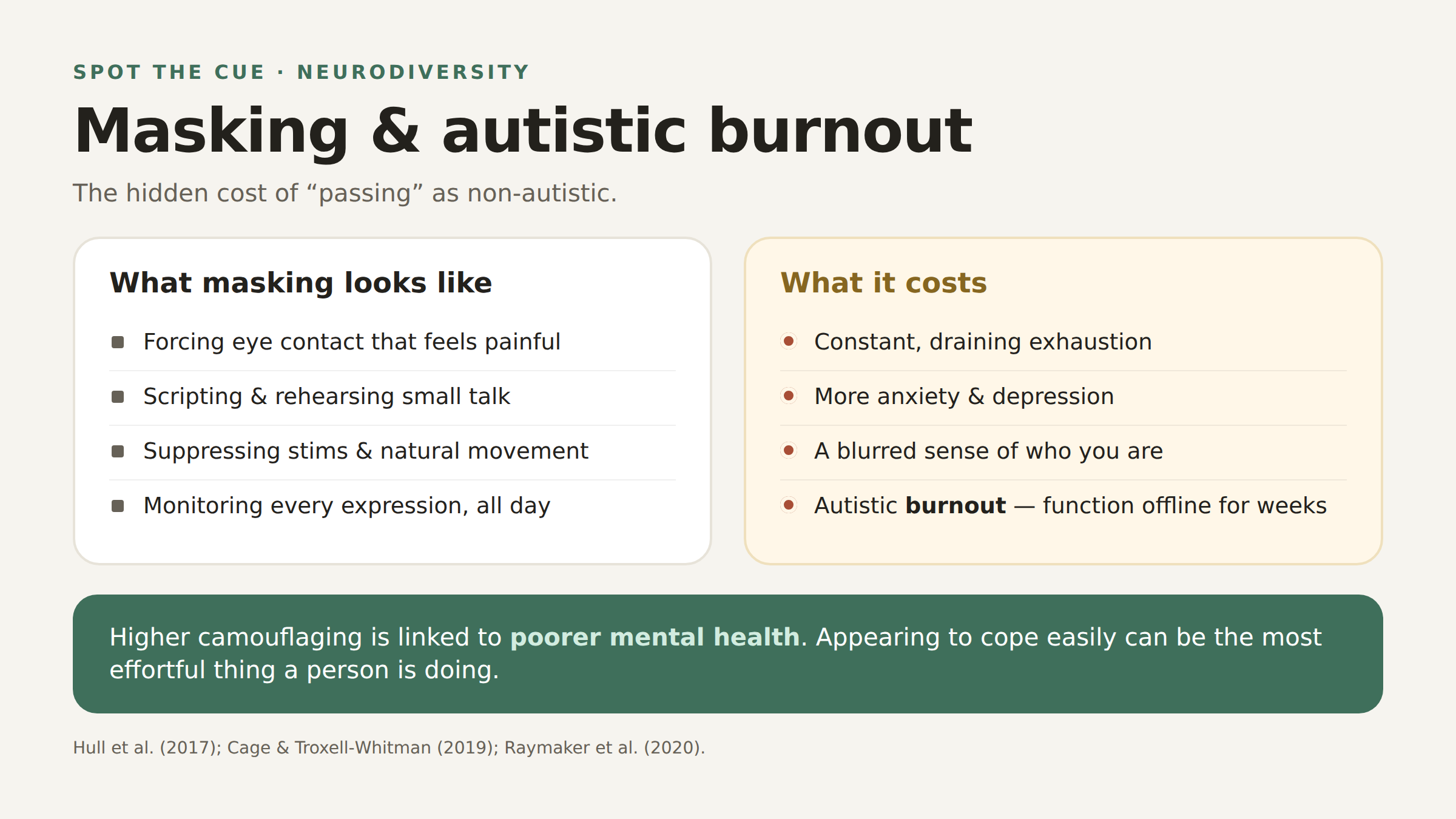
Masking, or camouflaging, is the conscious and unconscious work of hiding autistic traits and performing non-autistic ones to fit in. In the first in-depth study of it, Laura Hull and colleagues described two intertwined parts: masking — suppressing natural behavior, like stifling a stim or forcing eye contact that feels painful — and compensation — actively substituting learned strategies, like pre-scripting small talk or copying others’ facial expressions.1 It is skilled, effortful, and largely invisible, which is precisely the point.
People do it for concrete reasons. Autistic adults report camouflaging to stay safe, to keep jobs, to make and hold friendships, and to avoid the judgment that visible difference can attract. Cage and Troxell-Whitman found people mask differently across contexts — more at work, less with close friends — and for different motivations, from “conventional” assimilation to protection from harm.2 Masking is often a rational response to an unaccommodating environment, not a personal failing.
The cost
The trouble is that the performance runs on a depleting battery. Across studies, higher camouflaging is associated with more anxiety and depression, and autistic adults consistently describe it as mentally and physically draining — a constant background computation of how to look and sound.2 Some describe a further cost: after years of it, losing track of who they are underneath the performance.
Sustained long enough, and stacked on top of ordinary life stress without adequate support, this is one of the recognized drivers of autistic burnout — a state autistic adults define as pervasive, long-term exhaustion, loss of function, and reduced tolerance to stimulation. In the study that first defined it from autistic accounts, chronic masking and the mismatch between expectations and capacity were named again and again as central causes.3 Burnout here isn’t “tired”; it’s a systemic depletion that can take skills offline for weeks or months.
Myth If someone can act “normal” in public, social situations must not be hard for them.
What the research says For many masking people, appearing fine is the hard part — the calm surface is bought with continuous effort you don’t see. The absence of visible struggle is not the absence of struggle, and the “high-functioning” person who copes smoothly in the meeting may crash the moment they get home.13
What this means for reading cues
Two of the “cues” people are most confident about are exactly the ones masking distorts. Eye contact isn’t a reliable honesty signal — for many autistic people it’s effortful or even aversive, and forcing it can crowd out their ability to actually listen. Flat or unusual affect isn’t a reliable read on feeling. If your interpretation of someone depends on their performing neurotypical body language, you are measuring their mask, not them.
Don’t demand the mask
Notice when your comfort quietly requires someone else to perform — steady eye contact, animated expressions, no fidgeting. Relaxing that expectation is a real, low-cost accommodation.
Rethink eye contact
Treat looking away, or fidgeting while listening, as neutral. Plenty of people focus better without a face to manage. Judge attention by what they take in, not where their eyes point.
Read blunt and flat generously
Direct phrasing and even tone usually mean clarity, not coldness. Extend the benefit of the doubt you’d want extended to you.
Make unmasking safe
You can’t tell someone to stop masking, but you can lower the pressure to keep it up — by being predictable, saying what you mean, and not punishing difference when it shows.
Understanding masking changes what “good at reading people” even means. It’s not decoding a performance more cleverly — it’s lowering the stakes so the performance isn’t necessary. The generous, curious, cue-light way of reading others that Spot the Cue practices is, for a masking person on the other side, one less reason to keep the mask on.
Now try reading a cue under a little pressure.
Short scenarios, instant feedback — free to start, no sign-up.
Sources
- Hull, L., Petrides, K. V., Allison, C., Smith, P., Baron-Cohen, S., Lai, M.-C., & Mandy, W. (2017). “Putting on My Best Normal”: Social Camouflaging in Adults with Autism Spectrum Conditions. Journal of Autism and Developmental Disorders, 47(8), 2519–2534. Link ↗
- Cage, E., & Troxell-Whitman, Z. (2019). Understanding the reasons, contexts and costs of camouflaging for autistic adults. Journal of Autism and Developmental Disorders, 49(5), 1899–1911. Link ↗
- Raymaker, D. M., Teo, A. R., Steckler, N. A., Lentz, B., Scharer, M., Delos Santos, A., Kapp, S. K., Hunter, M., Joyce, A., & Nicolaidis, C. (2020). “Having all of your internal resources exhausted beyond measure and being left with no clean-up crew”: Defining autistic burnout. Autism in Adulthood, 2(2), 132–143. Link ↗
- Hull, L., Levy, L., Lai, M.-C., Petrides, K. V., Baron-Cohen, S., Allison, C., Smith, P., & Mandy, W. (2021). Is social camouflaging associated with anxiety and depression in autistic adults? Molecular Autism, 12, 13. Link ↗