The Double Empathy Problem: Miscommunication Is a Two-Way Street
When autistic and non-autistic people misunderstand each other, it has long been framed as an autistic deficit. A decade of research suggests the gap is mutual — and that reframing changes everything.
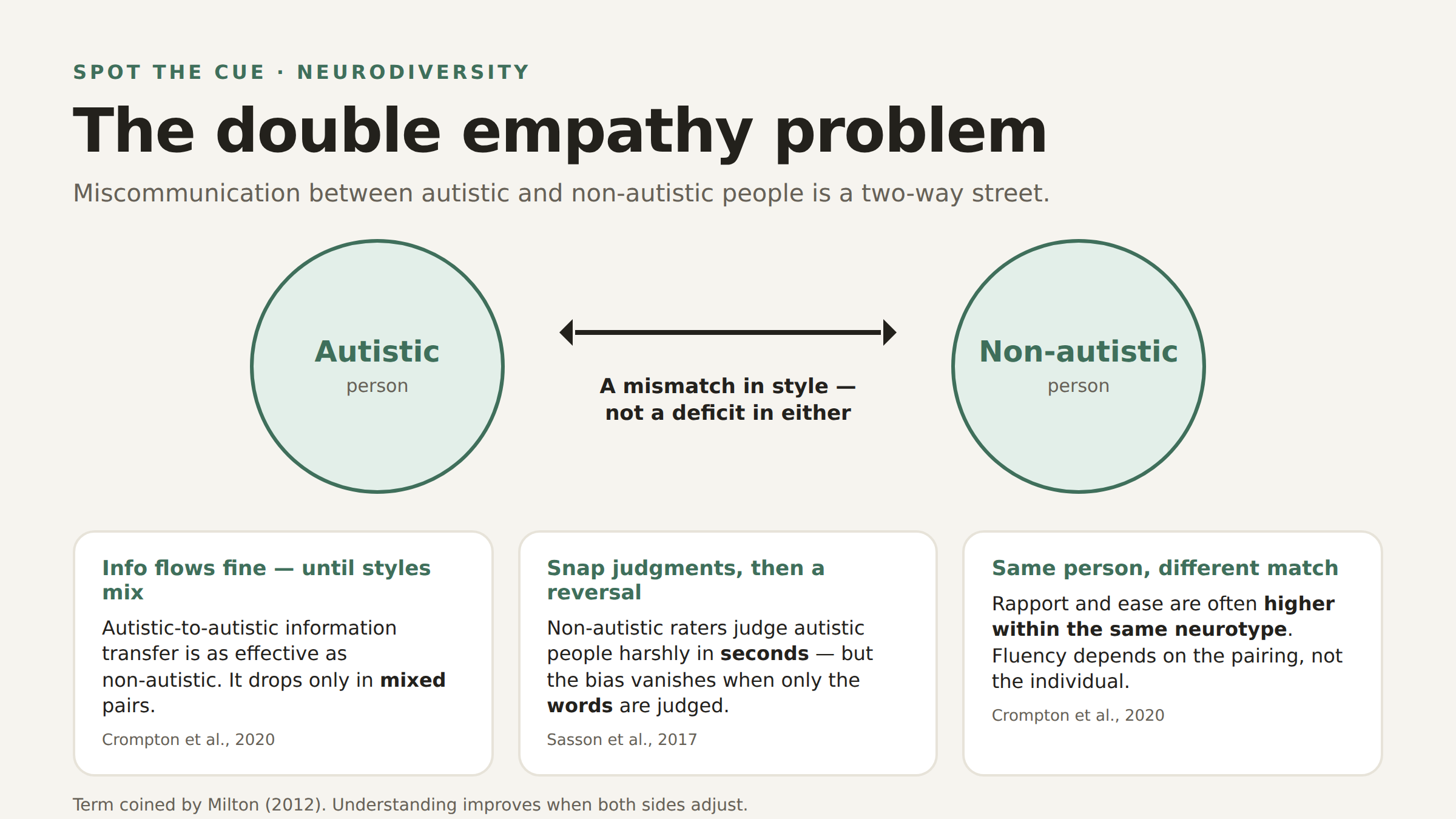
A deficit — or a mismatch?
For decades, the difficulty autistic people can have in conversation with non-autistic people was explained in one direction: autistic people were said to lack the machinery for reading others. In 2012, the autistic researcher Damian Milton proposed a different framing. Empathy between two people, he argued, is a two-way achievement — and when their ways of expressing and interpreting differ enough, both struggle to read the other. He called it the double empathy problem: a mutual gap, not a one-sided defect.1
It’s a subtle move with large consequences. If the difficulty is relational rather than located inside one person, then the non-autistic person misreading the autistic person is just as much “the problem” as the reverse — and the fix stops being “make autistic people communicate normally” and becomes “help two different styles meet.”
The evidence that it runs both ways
The strongest test came from Catherine Crompton and colleagues, who used a “diffusion chain” — the telephone game, run rigorously. A story was passed down chains of eight people: some chains all autistic, some all non-autistic, some mixed. Autistic chains passed the details along just as accurately as non-autistic chains. The transfer only degraded in the mixed chains — exactly what the double empathy account predicts, and the opposite of what a simple “autistic deficit” model would.2
A second study gets at first impressions. Noah Sasson’s team found that non-autistic people rated autistic adults as more awkward and less likeable — and were less keen to interact with them — within seconds, from thin slices of behavior. But here is the pivotal detail: when raters were given only a transcript of what the autistic person said, with no sight or sound of delivery, those negative judgments disappeared. The bias was about style and presentation, not the substance of what autistic people had to offer.3
And it isn’t only about accuracy — it’s about ease. Autistic adults often report better rapport, more relaxed flow, and less exhausting interaction with other autistic people than in mixed company.4 The same person can look “socially impaired” in one pairing and perfectly fluent in another. That’s a fact about the match, not the individual.
Myth Autistic people lack empathy and can’t read social cues.
What the research says The reading difficulty is mutual: non-autistic people are just as poor at reading autistic people as the reverse, and often worse at extending the benefit of the doubt. Autistic people frequently report deep empathy — sometimes overwhelming amounts of it — that simply isn’t expressed in the conventional register non-autistic observers are scanning for.13
Why the reframe matters
Treating the gap as mutual redistributes the work. It takes some of the lifelong pressure off autistic people to constantly translate themselves, and it asks non-autistic people to do something they rarely think to: question their own snap reads and adjust their own style. It also reframes a lot of everyday friction — the “blunt” email, the missed hint, the unexpected honesty — as a dialect difference to bridge rather than a rudeness to correct.
Assume difference, not deficit
When an exchange feels “off,” treat it as two styles not yet meshing — not evidence that the other person is cold, rude, or clueless. The mismatch is in the space between you, not inside them.
Say the quiet part out loud
A lot of double-empathy friction lives in unspoken subtext and implied hints. Being explicit — stating expectations, timelines, and feelings directly — removes the exact ambiguity both sides are prone to misreading.
Don’t penalize the delivery
Flat tone, limited eye contact, or unusual phrasing carry little information about warmth or competence. Judge what someone means and does, not the packaging it arrives in.
Interrogate the two-second verdict
The research shows first impressions of autistic people form fast and skew harsh. If you notice a snap “something’s off about them,” treat it as a bias to check, not a read to trust.
Share the bridging
Meeting halfway — asking what works for the other person, and naming what works for you — beats expecting one side to do all the adapting. Communication is a joint project.
The double empathy problem is ultimately a hopeful idea: if misunderstanding is mutual, so is the repair. Reading people well across neurotypes isn’t about one side performing normalcy — it’s about both sides getting curious, checking their assumptions, and meeting in the middle. That posture of humble, testable curiosity is the whole skill Spot the Cue is built to train.
Now try reading a cue under a little pressure.
Short scenarios, instant feedback — free to start, no sign-up.
Sources
- Milton, D. E. M. (2012). On the ontological status of autism: the ‘double empathy problem’. Disability & Society, 27(6), 883–887. Link ↗
- Crompton, C. J., Ropar, D., Evans-Williams, C. V. M., Flynn, E. G., & Fletcher-Watson, S. (2020). Autistic peer-to-peer information transfer is highly effective. Autism, 24(7), 1704–1712. Link ↗
- Sasson, N. J., Faso, D. J., Nugent, J., Lovell, S., Kennedy, D. P., & Grossman, R. B. (2017). Neurotypical peers are less willing to interact with those with autism based on thin slice judgments. Scientific Reports, 7, 40700. Link ↗
- Crompton, C. J., Hallett, S., Ropar, D., Flynn, E., & Fletcher-Watson, S. (2020). ‘I never realized everybody felt as happy as I do when I am around autistic people’: A thematic analysis of autistic adults’ relationships with autistic and neurotypical friends and family. Autism, 24(6), 1438–1448. Link ↗