Flirting, or Just Friendly? Why the Signal Is Noisier Than You Think
People are strikingly bad at detecting when someone is flirting — and strikingly good at detecting when they aren’t. Here is what the research shows, and the one move that beats guessing.
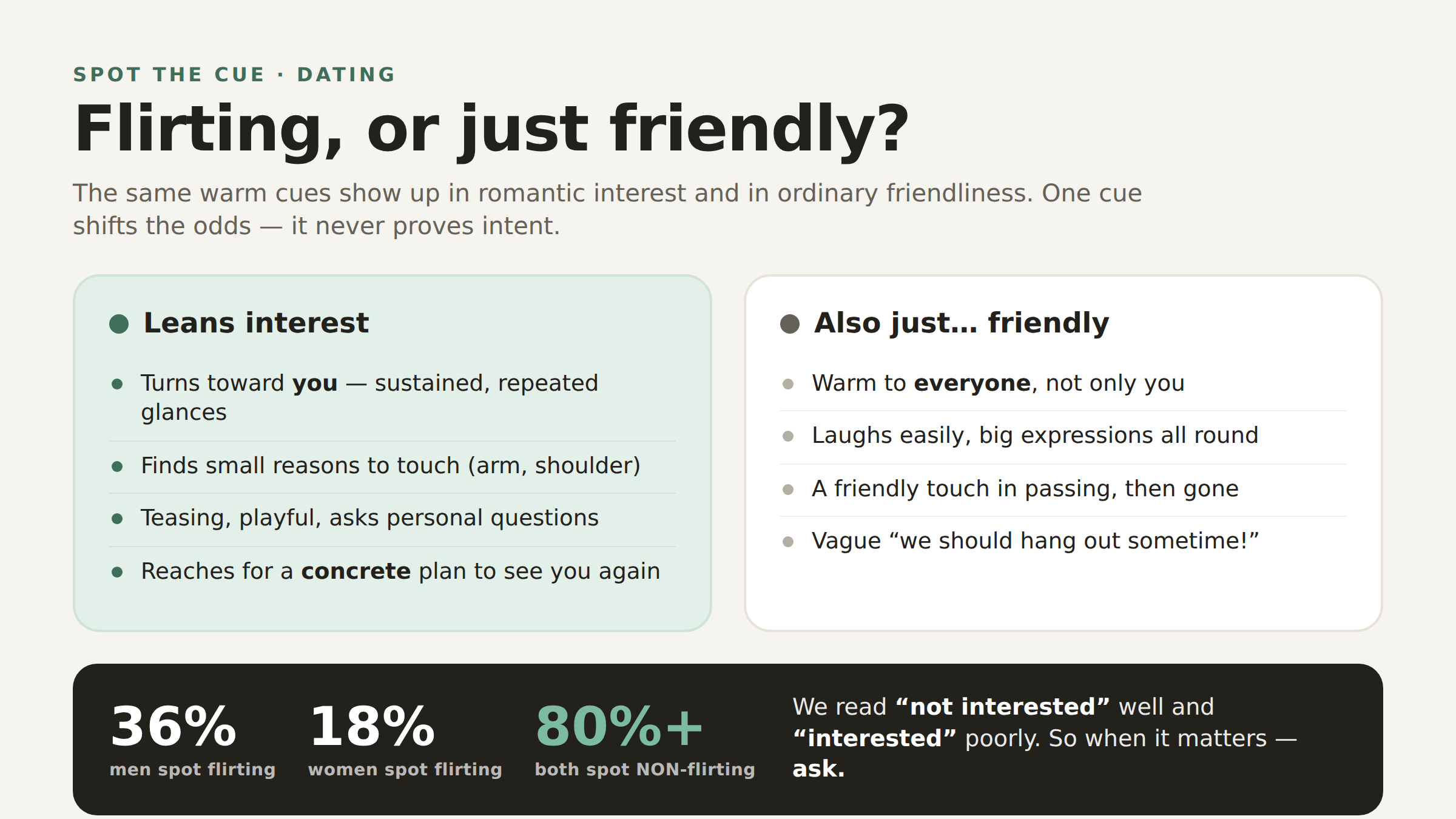
The signal is real — but quiet
Flirting has genuine nonverbal signatures. In classic observational work, Monica Moore catalogued dozens of recurring courtship behaviors — the extended glance, the head tilt, the “grooming” touch to the hair, the laugh — that reliably preceded approach in real social settings.2 So the cues exist. The problem is that they are subtle, easily confused with plain warmth, and — crucially — we read them badly.
The sharpest evidence comes from Jeffrey Hall and colleagues, who brought strangers together for real conversations and then asked each person whether the other had been flirting — checking those answers against what people privately reported doing. When someone was flirting, men noticed only about 36% of the time and women only about 18%. When someone was not flirting, both read it correctly more than 80% of the time.1
The asymmetry that should change how you read
Look at those numbers together and a pattern jumps out: we are good at detecting the absence of interest and poor at detecting its presence. As Hall put it, if you think someone isn’t interested, you’re probably right — but if they are, you probably missed it. For cue-reading that flips the usual worry on its head. The false alarm you fear — “what if I imagined the whole thing?” — is the rarer error. The quieter, more common one is failing to notice that someone actually liked you.
Myth A warm laugh, sustained eye contact, and a light touch on the arm mean someone is flirting with you.
What the research says Every one of those behaviors is also standard-issue friendliness. Warm, socially skilled people do all of them with friends, colleagues, and strangers they have no romantic interest in. A cue like this raises the probability of interest a little; it is not a verdict. The base rate of plain friendliness is high, so “they’re just being nice” is usually the safer first guess.1
Why we miss it — in both directions
Part of the trouble is that the same behavior means different things in different contexts, and we have no reliable calibration for it. There is also a documented gender pattern layered on top: in decoding studies, men tend to over-read women’s friendliness as sexual interest, while women tend to under-read men’s interest — differences that appear to come from how each group perceives and weighs ambiguous cues, not from one group “knowing better.”3 The upshot is the same either way: a single cue, read in isolation, is a coin-flip dressed up as a certainty.
Flirting itself often runs on this ambiguity by design. A softer, more indirect style is common precisely because it lets someone signal interest while keeping a face-saving exit if it isn’t returned — which means the clearest romantic signals are frequently the ones held back until it already feels safe.4 You are, in other words, often trying to read a message the sender is deliberately keeping deniable.
The move that beats guessing
If accuracy is low and the cost of a confident wrong read is high, the answer isn’t to stare harder for a magic tell. It’s to stop treating the read as a verdict and start treating it as a hypothesis you can test — gently, respectfully, and in a way that leaves everyone room.
Hold it as odds, not proof
Let a warm cue nudge your estimate — “maybe there’s something here” — without locking in a conclusion. One cue is weak evidence; a consistent pattern over time is stronger.
Escalate gently and read the response
Offer a small, low-stakes step — a specific plan, a slightly warmer message — and watch what comes back. A real yes tends to reach toward you; a soft no stays vague. You learn far more from one gentle test than from an hour of analysis.
When it matters, just ask
The most reliable instrument for another person’s interest is a kind, direct question — “I’ve enjoyed this; I’d like to take you to dinner, if you’re interested.” It trades the anxiety of guessing for a clear answer, and clarity is a kindness to both of you.
Take a no as information, warmly
If the answer is no — spoken or shown — treat it as useful data, not a wound. Reading disinterest accurately and letting it rest gracefully is a social skill in its own right, and the one the research says you’re already good at.
The freeing thing about the flirting research is that it lets you stop auditioning as a mind-reader. Nobody is good at this from cues alone — so the confident, attractive move isn’t a better guess, it’s the willingness to check. That’s a skill you can practice one low-stakes read at a time, which is exactly what Spot the Cue is for.
Now try reading a cue under a little pressure.
Short scenarios, instant feedback — free to start, no sign-up.
Sources
- Hall, J. A., Xing, C., & Brooks, S. (2015). Accurately detecting flirting: Error management theory, the traditional sexual script, and flirting base rate. Communication Research, 42(7), 939–958. Link ↗
- Moore, M. M. (1985). Nonverbal courtship patterns in women: Context and consequences. Ethology and Sociobiology, 6(4), 237–247. Link ↗
- Farris, C., Treat, T. A., Viken, R. J., & McFall, R. M. (2008). Perceptual mechanisms that characterize gender differences in decoding women’s sexual intent. Psychological Science, 19(4), 348–354. Link ↗
- Hall, J. A., & Xing, C. (2015). The verbal and nonverbal correlates of the five flirting styles. Journal of Nonverbal Behavior, 39(1), 41–68. Link ↗