What Laughter Really Signals (Hint: It’s Rarely About the Joke)
Most laughter isn’t a reaction to something funny. It’s a social signal, and people pick up more from it than you might expect, though less than they think.
Why do people laugh when nothing is funny?
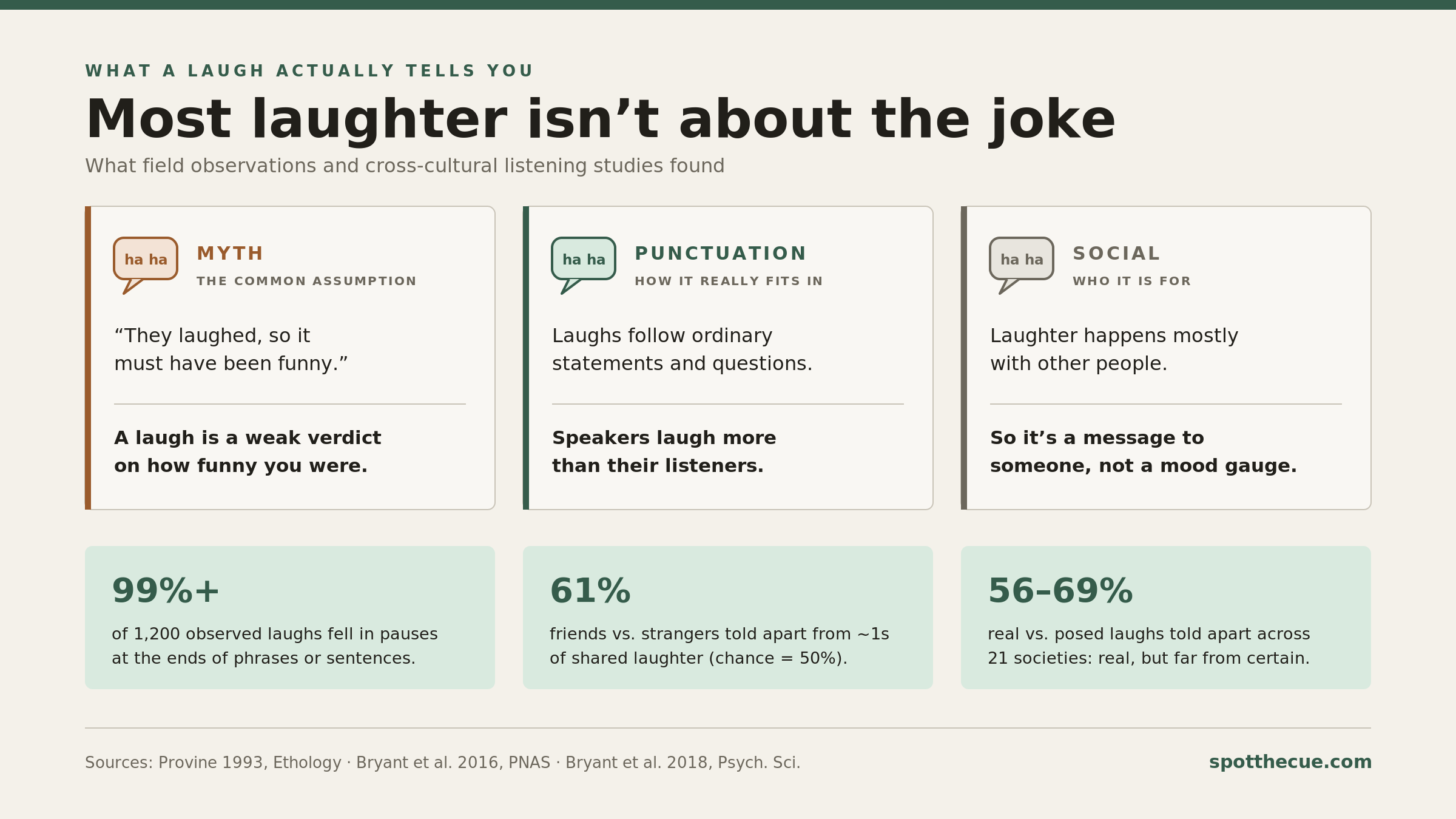
Because laughter is mostly about the relationship, not the material. The psychologist Robert Provine and his students spent years quietly observing naturally occurring laughter among young adults in public places. In a sample of 1,200 laugh episodes, laughter “followed both statements and questions and material that did not seem humorous outside of the conversational context.” And the person talking, especially when that person was a woman, laughed more than the people listening.1 Looking back on this work, Provine summed it up plainly: laughter “is not typically humor related.”3
Myth People laugh because something is funny. So if someone laughs, your joke landed, and if they don’t, it bombed.
What the research says In Provine’s field observations, laughter regularly followed remarks that weren’t funny out of context, and speakers laughed more than their audiences.1 A laugh tells you more about how the moment feels between two people than about the quality of the line. Plenty of good jokes get a smile instead, and plenty of ordinary remarks get a laugh.
Laughter is built for company
In an earlier study, Provine and Kenneth Fischer asked undergraduates to keep a log of every time they laughed, smiled or talked over a week. All three were “most frequent in social situations,” and smiles and laughs, like talking, were “performed primarily during social encounters.” The authors drew a practical conclusion: because laughing and smiling are social acts, they are “of limited value as indices of ongoing” emotional state.2 In other words, a laugh is a message to someone, not a readout of how they feel inside.
Laughter also fits neatly around speech. In the 1,200 episodes Provine studied, laughter landed in pauses at the ends of phrases or sentences more than 99% of the time, rather than cutting into the middle of a phrase.1 It works a little like punctuation: a small vocal mark that says “this is light,” “I’m with you,” or “we’re fine.”
Can you hear the difference between a real laugh and a polite one?
Somewhat. Nadine Lavan, Sophie Scott and Carolyn McGettigan recorded nine women laughing two ways: spontaneously, at videos they had chosen, and on purpose. The spontaneous laughs were higher in pitch, longer, and contained far more breathy, unvoiced sound. Listeners labelled about 69% of the spontaneous laughs as “real” and correctly identified about three-quarters of the posed laughs as posed.6 But the researchers point out that these laughs had been pre-selected because they were easy to categorize, so in everyday life accuracy is likely lower.6
A larger cross-cultural study played 36 laughs to 884 listeners in 21 societies around the world. People told spontaneous from volitional laughter apart with an accuracy of 56% to 69%, and the sound features linked to vocal arousal predicted their judgments fairly consistently across cultures.5 So there is something to hear. In a single moment, though, you will often be wrong.
It also helps to remember what a posed laugh is for. Researchers describe conversational laughter as a signal of things like agreement and liking.6 A polite laugh is not a lie. It is a courtesy: “I’m following you, and this is friendly.”
Shared laughter says something about the relationship
In one of the most striking studies, 966 listeners from 24 societies heard brief clips, about a second long, of two American college students laughing at the same moment in conversation. Some pairs were friends; others had just met. Listeners guessed which was which correctly 61% of the time, against 50% for guessing, with accuracy across sites ranging from 53% to 67%. Even listeners with essentially no familiarity with English could do it. Their “friends” judgments tracked features associated with spontaneous, aroused laughter, such as shorter bursts with less regular pitch and loudness.4
That is a real signal, but a noisy one. Listeners everywhere tended to call pairs of women friends whether they were or not, and the whole study rests on one set of 48 clips recorded in 2003.4 The authors themselves call it “strong preliminary evidence.”4
Something similar shows up in close relationships. Laura Kurtz and Sara Algoe coded the laughter of 71 couples as they talked about how they first met. Controlling for all the other laughter in the conversation, the share of time partners spent laughing simultaneously was uniquely linked to how they rated their relationship’s quality, closeness and support.7 That is a correlation, so it doesn’t show that laughing together causes closeness; it may simply reflect it. Either way, shared laughter looks like a better cue than laughter in general.
How to use this
Stop grading yourself by the laugh
Whether someone laughs is weak evidence about how funny you were. It is better evidence about whether they feel at ease with you, and that is usually what you actually wanted to know.
Expect laughs after ordinary remarks
When someone laughs after saying something plain, such as a request or a small complaint, they are often keeping things light rather than inviting a comeback. A smile or a small laugh back is usually enough.
Laughing at your own line is normal
If you worry that laughing while you talk makes you look as though you find yourself hilarious, the research suggests speakers do it more than listeners all the time.1 It is ordinary conversational punctuation.
Don’t hunt for “fake” laughs
Even with clean lab recordings, people only tell real from posed laughter moderately better than chance.5 Treat a polite laugh as politeness, which is itself a friendly signal.
Notice laughter that is shared
Two people laughing at the same moment is one of the more meaningful laughter cues, but still a hint rather than proof. Look for whether it keeps happening across a conversation.
Read the pattern, not the moment
One laugh tells you little. Whether laughter keeps coming, whether it is mutual, and whether the person keeps engaging with you tells you much more.
Where the evidence runs out
A few honest caveats. Provine’s work is observational and draws on young adults in public places.1 The friends-and-strangers study used a single set of short clips from American undergraduates.4 The real-versus-posed accuracy figures come from laughs recorded in controlled conditions, some of them pre-selected for being easy to tell apart.6 And the couples study is correlational.7 None of this research tells you what one particular nervous or awkward laugh means; the surrounding context does far more of that work than the sound itself.
What survives is a useful shift in perspective. Laughter is less a review of your material and more a running signal about the relationship: are we comfortable, are we on the same side, is this moment light? If you’d like to practice reading cues like these in context rather than in isolation, our guide to reading social cues and free practice scenarios are a low-stakes place to start.
Now try reading a cue under a little pressure.
Short scenarios, instant feedback. Free to start, no sign-up.
Sources
- Provine, R. R. (1993). Laughter punctuates speech: Linguistic, social and gender contexts of laughter. Ethology, 95(4), 291–298. Link ↗
- Provine, R. R., & Fischer, K. R. (1989). Laughing, smiling, and talking: Relation to sleeping and social context in humans. Ethology, 83(4), 295–305. Link ↗
- Provine, R. R. (2004). Laughing, tickling, and the evolution of speech and self. Current Directions in Psychological Science, 13(6), 215–218. Link ↗
- Bryant, G. A., Fessler, D. M. T., Fusaroli, R., Clint, E., Aarøe, L., Apicella, C. L., Petersen, M. B., et al. (2016). Detecting affiliation in colaughter across 24 societies. Proceedings of the National Academy of Sciences, 113(17), 4682–4687. Link ↗
- Bryant, G. A., Fessler, D. M. T., Fusaroli, R., Clint, E., Amir, D., Chávez, B., et al. (2018). The perception of spontaneous and volitional laughter across 21 societies. Psychological Science, 29(9), 1515–1525. Link ↗
- Lavan, N., Scott, S. K., & McGettigan, C. (2016). Laugh like you mean it: Authenticity modulates acoustic, physiological and perceptual properties of laughter. Journal of Nonverbal Behavior, 40(2), 133–149. Link ↗
- Kurtz, L. E., & Algoe, S. B. (2015). Putting laughter in context: Shared laughter as behavioral indicator of relationship well-being. Personal Relationships, 22(4), 573–590. Link ↗