How to End a Conversation: The One Cue Almost Nobody Can Read
You scan for the moment they’ve had enough. Across 932 conversations, almost nobody found it. The ending you replay later is usually mutual, not personal.
How do you end a conversation?
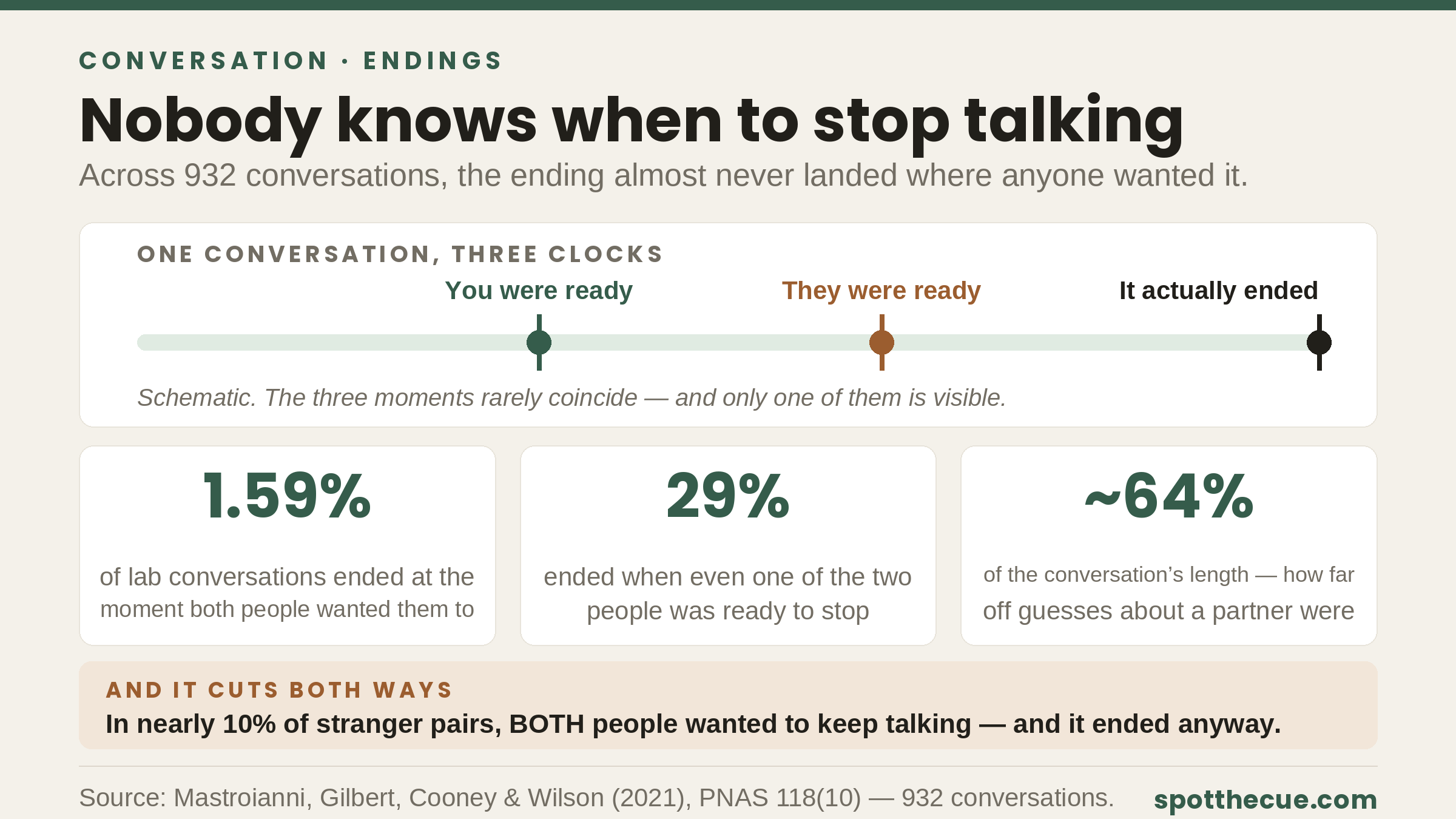
Say it, rather than wait to detect it. Across 932 conversations, people could not tell when their partner wanted to stop: guesses were off by roughly 64% of the conversation’s length, and only 1.59% of conversations ended at the moment both people were ready.1 Scanning harder doesn’t help, because the information is being hidden by politeness on both sides. Naming your own exit (“I should let you go”) is the one move that doesn’t depend on reading a cue nobody can read.
The cue everyone is straining to read
You’re ten minutes into a conversation and part of your attention has quietly left the room. It’s running a background process: do they want to go? You’re watching for the shifted weight, the glance past your shoulder, the reply that came a half-beat short. There’s bad news and good news. The bad news is that this particular cue is close to unreadable. The good news is that it’s unreadable for everyone — which means a lot of what you’ve filed away as "I was boring them" was never actually in the data.
What 932 conversations showed
In 2021, Adam Mastroianni and colleagues did something obvious that nobody had done: they asked both people in a conversation when they had wanted it to stop. Study 1 surveyed 806 people about a recent conversation with someone close to them. Study 2 put 252 strangers into 126 pairs in a lab and let them talk for as long as they liked, anywhere from one minute to forty-five.1
The results are close to comic. Of the lab conversations, just 1.59% ended at the moment both people wanted them to. Loosen the bar so the conversation only has to end when one of the two was ready, and you still get only 29.37%. The average gap between when someone wanted to stop and when things actually stopped came to roughly half the length of the conversation itself: 56% of it in the survey study, 46% in the lab (medians 46% and 31%).1
You’re not bad at this. Nobody can do it.
Here’s the part that should take some weight off. In the lab study, participants also guessed when their partner had wanted to stop. Those guesses were off by an average of 64% of the conversation’s total length (median 43%).1 Not off by a minute or two — off by a stretch comparable to the whole conversation. And the target was moving anyway: the two partners’ actual stopping points differed from each other by about 68% of the conversation’s length on average.1
The authors describe this as a coordination problem people can’t solve, because solving it would require information they deliberately keep from each other. We call that withholding politeness with strangers and kindness with people we love, but the effect is identical: the single fact that would let an ending land well is the one fact nobody puts on the table.1
Myth If they wanted to leave, I’d be able to tell.
What the research says You almost certainly wouldn’t. When researchers asked people to say when their conversation partner had wanted to stop, the estimates missed by roughly two-thirds of the conversation’s length on average. People also failed to notice how far apart their two preferences were to begin with.1 This isn’t a skill gap you can close by watching harder. The information isn’t on the outside of the person.
The most encouraging number in the paper
Buried in the discussion is a finding worth sitting with. In nearly 10% of the stranger pairs, both people wanted to keep talking — and the conversation ended anyway.1 Two people, each waiting for a signal from the other, each politely declining to say "I’m enjoying this," both walking away from something they wanted. And only about two-thirds of participants ever felt ready to end at all (66.5% in Study 1, 68.7% in Study 2), which means roughly a third never wanted the conversation to stop.1
So when a conversation trails off and you replay it that evening as proof you overstayed: the base rates don’t support the reading. A clumsy ending is the ordinary output of an unsolvable coordination problem. There’s a real chance the person across from you was on the other side of it, hoping you’d stay.
What leave-taking actually looks like
None of this means endings are structureless. They’re just structured after someone has decided to go, not before. In their foundational 1973 paper, Schegloff and Sacks showed that conversations don’t simply stop. They’re brought to a close through a coordinated sequence. The opening move is what they named a possible pre-closing: "We-ell…", "O.K.…", "So-oo…", said with falling intonation and nothing after it.2
The word possible is doing real work there. A pre-closing isn’t a verdict; it’s an offer. It opens a slot for anything left unsaid, and if the other person puts something in that slot, the conversation reopens and carries on. Schegloff and Sacks describe one transcript running eighty-five pages in which the first possible pre-closing arrives on page twenty.2 Hearing "well…" isn’t being dismissed. It’s being asked.
The physical version was mapped the same year. Knapp and colleagues videotaped the final moments of staged interviews and found that the nonverbal leave-taking behaviors (breaking eye contact, angling the body away, leaning forward, head-nodding) nearly all peaked in the last fifteen seconds before someone stood up, with handshakes and the body turn peaking just after.3 Verbally, the standard kit was reinforcement ("yeah," "right," "uh-huh"), buffers ("well," "uh"), appreciation ("thanks for your time"), and legitimizers ("I guess I’m finished").3
How to use this
Stop hunting for the exit cue mid-conversation
The research says the desire to leave isn’t legible from the outside until someone has decided to act on it. Scanning for it costs you attention you could spend on the conversation itself, and it reliably manufactures false positives.
Weight the last fifteen seconds, not the middle
Real leave-taking clusters right before someone rises: eye contact breaks, the body angles off, the nodding speeds up, the "yeah, yeah" arrives. A glance at a phone in minute six is far weaker evidence than any of that.
Make the offer instead of waiting for the signal
A pre-closing is an offer, so give a real one: "I should get going soon — anything else before I do?" That hands the other person the exact information the studies show they can’t read off your face, and leaves them a genuine opening.
Say it when you want to stay
Roughly one in ten stranger pairs both wanted to keep talking and stopped anyway. "I’m enjoying this — do you have a few more minutes?" costs very little and is the only thing that breaks that deadlock.
Assume mutual, not personal
When an ending lands badly, the base rate says the other person’s clock was off too. Almost nobody wins this game, which makes "it got awkward" much weaker evidence about you than it feels at the time.
Where the research stops
A few caveats to carry. Study 1 asked people to recall a conversation from earlier that day or the day before, so memory is in the loop. Study 2 fixed that by observing real conversations, but they were first meetings between strangers in a lab who’d been told up front they could talk for between one and forty-five minutes — not quite ordinary life. The distributions are also skewed, which is why the medians sit well below the means: "about half the conversation" fairly summarizes the average, not every case. And the leave-taking findings come from a small set of staged five-minute interviews recorded in 1973. That makes them a useful description of how leaving gets performed, not a universal law.13
What survives all of that is the shape of the thing: the desire to end a conversation is a private state, and reading it off someone isn’t a skill you’ve failed to develop. It also fits a broader pattern. People systematically underestimate how much others want to talk with them, and then act on the underestimate.5
The practical move is small and slightly uncomfortable: say the thing rather than hunt for the cue. That’s a rep like any other, and it’s one you can rehearse. Our out-loud practice includes exactly these moments, from leaving a gathering without over-explaining to holding a conversation open when you’d rather it kept going. It’s free to start and needs no sign-up.
Now try reading a cue under a little pressure.
Short scenarios, instant feedback. Free to start, no sign-up.
Sources
- Mastroianni, A. M., Gilbert, D. T., Cooney, G., & Wilson, T. D. (2021). Do conversations end when people want them to? Proceedings of the National Academy of Sciences, 118(10), e2011809118. Link ↗
- Schegloff, E. A., & Sacks, H. (1973). Opening up closings. Semiotica, 8(4), 289–327. Link ↗
- Knapp, M. L., Hart, R. P., Friedrich, G. W., & Shulman, G. M. (1973). The rhetoric of goodbye: Verbal and nonverbal correlates of human leave-taking. Speech Monographs, 40(3), 182–198. Link ↗
- Chen, J., Short, M., & Kemps, E. (2020). Interpretation bias in social anxiety: A systematic review and meta-analysis. Journal of Affective Disorders, 276, 1119–1130. Link ↗
- Epley, N., Kardas, M., Zhao, X., Atir, S., & Schroeder, J. (2022). Undersociality: Miscalibrated social cognition can inhibit social connection. Trends in Cognitive Sciences, 26(5), 406–418. Link ↗