How to Tell If Someone Is Lying (What Actually Works)
Not from their face. Six decades of research point somewhere else entirely — and the honest answer is more useful than the one you were looking for.
The question everyone actually asks
People rarely want a lecture on base rates. They want to know whether the person in front of them is telling the truth — about where they were, about the invoice, about whether they are fine. It is a completely reasonable thing to want, and the honest answer is that you will not get it from their face. That sounds like a refusal. It is not: it is a redirection toward the things that do work, which are less satisfying and considerably more effective.
What the numbers say
The anchor figure comes from a meta-analysis pooling 206 studies and 24,483 people: average accuracy at telling lies from truths was 54%, against a 50% baseline. People correctly identified 61% of truths and only 47% of lies.1
The more interesting number is where that accuracy comes from. In the same analysis, judges given video only performed worst — the visible channel produced an accuracy effect size of just d = .077, while audio came in at .419. Watching a face does not merely fail to help. Judges with video were also the most likely to call an honest person a liar.1
The cues you were taught are, meta-analytically, zero
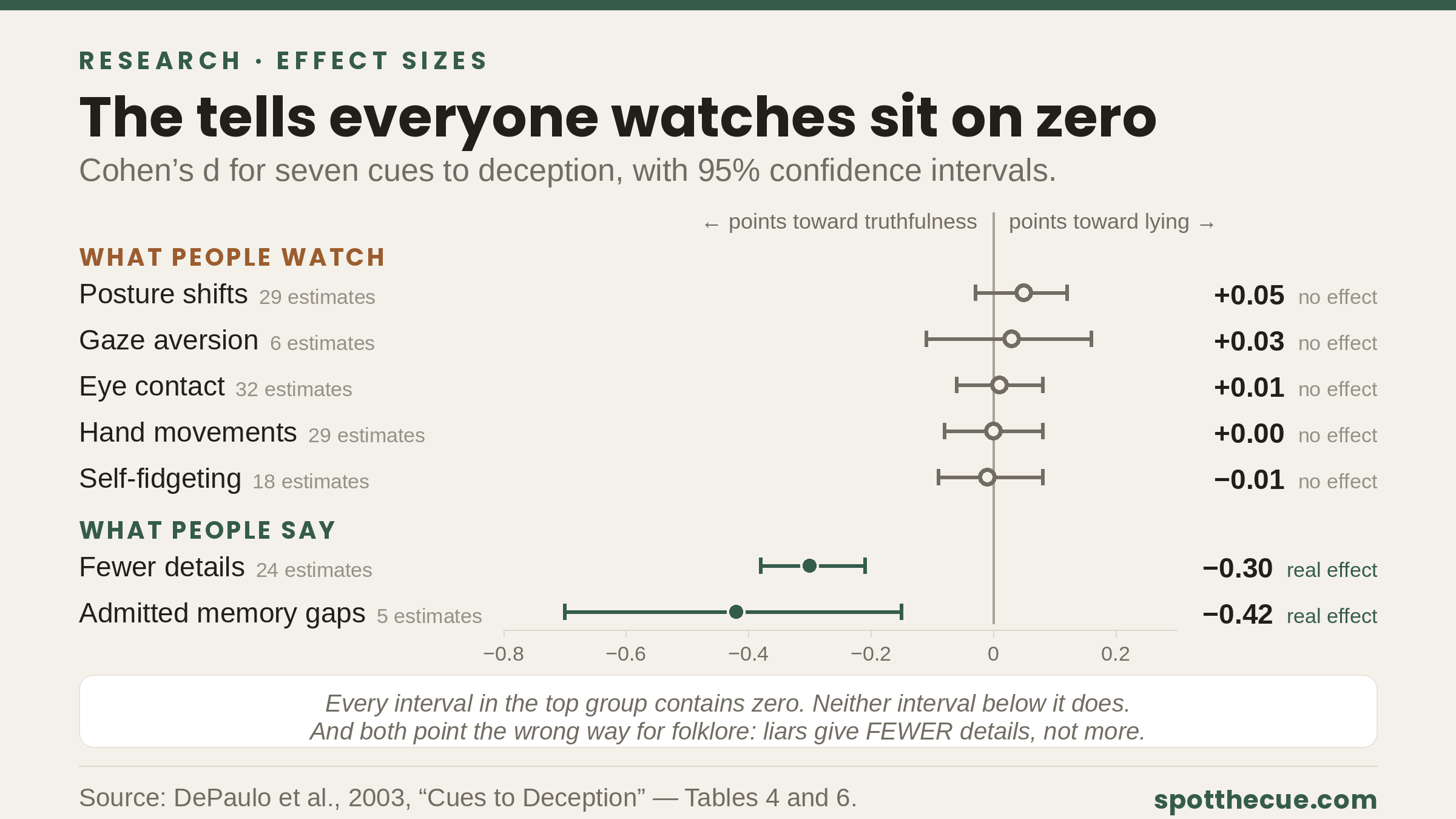
A separate meta-analysis examined 1,338 estimates of 158 cues across 120 independent samples. Here is what the most-taught ones actually came out at:2
- Eye contact: d = 0.01 (32 independent estimates, n = 1,491)
- Gaze aversion: d = 0.03
- Hand movements: d = 0.00
- Self-fidgeting: d = −0.01 — very slightly the wrong way
- Posture shifts: d = 0.05
- Filled pauses ("um", "ah"): d = 0.00; response latency: d = 0.02
The authors put it plainly: "none of the measures of looking behavior supported the widespread belief that liars do not look their targets in the eye," and "there is no clear relationship between fidgeting and lying."2
Myth Liars avoid eye contact.
What the research says This is the most widespread belief about lying on earth — a study across 75 countries and 43 languages found gaze aversion to be the dominant pan-cultural stereotype, named spontaneously by 64% of respondents and the top belief in 51 of 58 countries.3 It is also 0.03. A near-universal belief and a real cue are different things, and anyone who knows the stereotype can simply hold your gaze.
Myth Too much detail means the story was rehearsed.
What the research says The direction runs the opposite way. Across 24 independent estimates, liars gave fewer details, not more (d = −0.30).2 Superfluous detail (−0.01) and unusual detail (−0.16) did not discriminate at all.
Myth "I don’t remember" is a dodge.
What the research says Admitted lack of memory is d = −0.42 — one of the strongest cues in the entire corpus, and it points toward truthfulness.2 Truth-tellers admit gaps because they are remembering. Fabricated accounts tend to be seamless, because they are being constructed.
Myth Some people are natural human lie detectors.
What the research says Across 247 samples, measurement-corrected differences in judge ability were under one percentage point, and "the best judges are no more accurate than a stochastic mechanism would produce."4 People differ much more in how suspicious they are than in how accurate.
The failure is not in the reader
It is tempting to conclude that people are simply watching the wrong things. A lens-model meta-analysis covering 66 cues across 153 samples found otherwise: "contrary to previous assumptions, people rarely rely on the wrong cues. Instead, limitations in lie detection accuracy are mainly attributable to weaknesses in behavioral cues to deception."5
That reframes the whole problem. You are not failing a perception task. You are being asked to extract information that is not in the room.
What does move the needle
Every technique that reliably raises accuracy does it by acquiring information, never by perceiving better:
- Content in context: 75% vs 57% for controls6
- Strategic questioning: 68% vs 44% when asking background questions instead7
- Strategic Use of Evidence: 85.4% vs 56.1% for untrained interviewers8
Notice what those have in common. None is a way of looking. Strategic Use of Evidence works by withholding what you already know and letting an account commit to something that contradicts it — which means it requires evidence you have gone and gathered. Investigate first, then ask.
The one habit worth building
The most consumer-usable idea in this literature is verifiability: notice whether an account contains checkable details, and then check them. What makes it unusual is that telling someone in advance you will check makes it work better — truth-tellers add verifiable detail, liars do not.11 It is a research act rather than a perception act, and it is the one behavior worth installing.
Manipulation is a different question — and more learnable
Deception detection is a weak skill. Recognizing pressure is a much better bet, because manipulation is structural: it exists in what is said and what happens over time, not in a twitch.
DARVO
Deny, attack, and reverse victim and offender. In controlled studies, observers shown this pattern rated the person raising the complaint as less believable and more to blame, and endorsement of any consequence fell from 82% to 61%.12 The tell is structural: the original point is never engaged with.
Manufactured urgency
A deadline exists to remove the pause in which you would have checked. Deliberation is one of the few things shown to improve judgment, and a genuine offer survives you sleeping on it.
The small ask first
Agreeing to something small makes a larger request easier to agree to. That is why "but I said yes every time" is the wrong test — the right one is the distance traveled.
Isolation
Never a single objectionable moment, which is exactly how it works. It is the most consistently documented component of coercive control, and it is visible only when you total it up.
Myth Love bombing is an early warning sign you can spot.
What the research says This is the most confidently asserted unevidenced claim in the genre. The universally cited source is an undergraduate student research journal — a single cross-sectional survey.13 There is no validated measure, no prospective evidence that early intensity predicts later abuse, and no evidence anyone can distinguish it from ordinary new-relationship enthusiasm in real time. Generosity is not a warning sign. What is documented is the isolation, and the invoice that arrives when you make other plans.
The cost of getting this wrong
Suspicion is not free, and the math is unkind. Across a US national survey of 998 people, the median number of lies told in the past 24 hours was zero — 59.9% reported none, and almost half of all lies were told by 5% of people.14 Observed accuracy is a linear function of how honest the population actually is, which means that at real base rates, believing people is the accuracy-maximizing strategy.15
It gets worse than neutral. Suspicion is partly self-fulfilling: truth-tellers who are suspected begin behaving in ways that look dishonest, an effect the authors described as "a seeming confirmation of false accusations" rather than a mere perceptual distortion.16 And the people who pay for this are not distributed evenly. In a study with 1,410 observers, autistic adults telling the truth were rated as more deceptive — while the specific behaviors observers blamed did not actually differ between groups. It came from a diffuse impression that something was off.17
So what do you actually do
Assume honesty, because it is right most of the time. Ask better questions rather than watching harder. Notice what in an account could be checked, and check it. Learn the pressure patterns, which are real and structural. And treat your own confidence with suspicion — across five independent estimates, the correlation between how sure people are and how accurate they are runs about .04.19
That is what our Spot the Lie section drills, and it is scored differently from anything else we build: on both numbers. What you catch, and how often you read an honest person as a liar. A drill that only counted the first would be training suspicion and calling it skill — and the forensic literature shows exactly where that leads. Content-based statement analysis reports around 70% accuracy until you tune it to avoid calling true statements lies, at which point detection of real deception collapses to 9%.20 Try Level 1, free.
Now try reading a cue under a little pressure.
Short scenarios, instant feedback — free to start, no sign-up.
Sources
- Bond, C. F., Jr., & DePaulo, B. M. (2006). Accuracy of deception judgments. Personality and Social Psychology Review, 10(3), 214–234. Link ↗
- DePaulo, B. M., Lindsay, J. J., Malone, B. E., Muhlenbruck, L., Charlton, K., & Cooper, H. (2003). Cues to deception. Psychological Bulletin, 129(1), 74–118. Link ↗
- The Global Deception Research Team. (2006). A world of lies. Journal of Cross-Cultural Psychology, 37(1), 60–74. Link ↗
- Bond, C. F., Jr., & DePaulo, B. M. (2008). Individual differences in judging deception: Accuracy and bias. Psychological Bulletin, 134(4), 477–492. Link ↗
- Hartwig, M., & Bond, C. F., Jr. (2011). Why do lie-catchers fail? A lens model meta-analysis of human lie judgments. Psychological Bulletin, 137(4), 643–659. Link ↗
- Blair, J. P., Levine, T. R., & Shaw, A. S. (2010). Content in context improves deception detection accuracy. Human Communication Research, 36(3), 423–442. Link ↗
- Levine, T. R., Shaw, A., & Shulman, H. C. (2010). Increasing deception detection accuracy with strategic questioning. Human Communication Research, 36(2), 216–231. Link ↗
- Hartwig, M., Granhag, P. A., Strömwall, L. A., & Kronkvist, O. (2006). Strategic use of evidence during police interviews. Law and Human Behavior, 30(5), 603–619. Link ↗
- Mac Giolla, E., & Luke, T. J. (2021). Does the cognitive approach to lie detection improve the accuracy of human observers? Applied Cognitive Psychology, 35(2), 385–392. Link ↗
- Blair, J. P., Levine, T. R., & Vasquez, B. E. (2015). Producing deception detection expertise. Policing: An International Journal, 38(1), 71–85. Link ↗
- Nahari, G., Vrij, A., & Fisher, R. P. (2014). The Verifiability Approach. Applied Cognitive Psychology, 28(1), 122–128. Link ↗
- Harsey, S. J., & Freyd, J. J. (2023). The influence of DARVO and insincere apologies on perceptions of sexual assault. Journal of Interpersonal Violence. Link ↗
- Strutzenberg, C. C., Wiersma-Mosley, J. D., Jozkowski, K. N., & Becnel, J. N. (2017). Love-bombing: A narcissistic approach to relationship formation. Discovery, 18(1), 81–89. (An undergraduate student research journal, not a peer-reviewed venue.) Link ↗
- Serota, K. B., Levine, T. R., & Boster, F. J. (2010). The prevalence of lying in America. Human Communication Research, 36(1), 2–25. Link ↗
- Levine, T. R., Kim, R. K., Park, H. S., & Hughes, M. (2006). Deception detection accuracy is a predictable linear function of message veracity base-rate. Communication Monographs, 73(3), 243–260. Link ↗
- Bond, C. F., Jr., & Fahey, W. E. (1987). False suspicion and the misperception of deceit. British Journal of Social Psychology, 26(1), 41–46. Link ↗
- Lim, A., Young, R. L., & Brewer, N. (2022). Autistic adults may be erroneously perceived as deceptive and lacking credibility. Journal of Autism and Developmental Disorders, 52(2), 490–507. Link ↗
- Herlihy, J., Scragg, P., & Turner, S. (2002). Discrepancies in autobiographical memories — implications for the assessment of asylum seekers: repeated interviews study. BMJ, 324(7333), 324–327. Link ↗
- DePaulo, B. M., Charlton, K., Cooper, H., Lindsay, J. J., & Muhlenbruck, L. (1997). The accuracy-confidence correlation in the detection of deception. Personality and Social Psychology Review, 1(4), 346–357. Link ↗
- Brennen, T., & Magnussen, S. (2023). Lie detection: What works? Current Directions in Psychological Science, 32(5), 395–401. Link ↗