The Illusion of Transparency: Your Nerves Are More Private Than They Feel
Before you speak up, you’re sure everyone can see you’re nervous. The research says they mostly can’t — and knowing that can actually make you calmer.
The feeling that everyone can see it
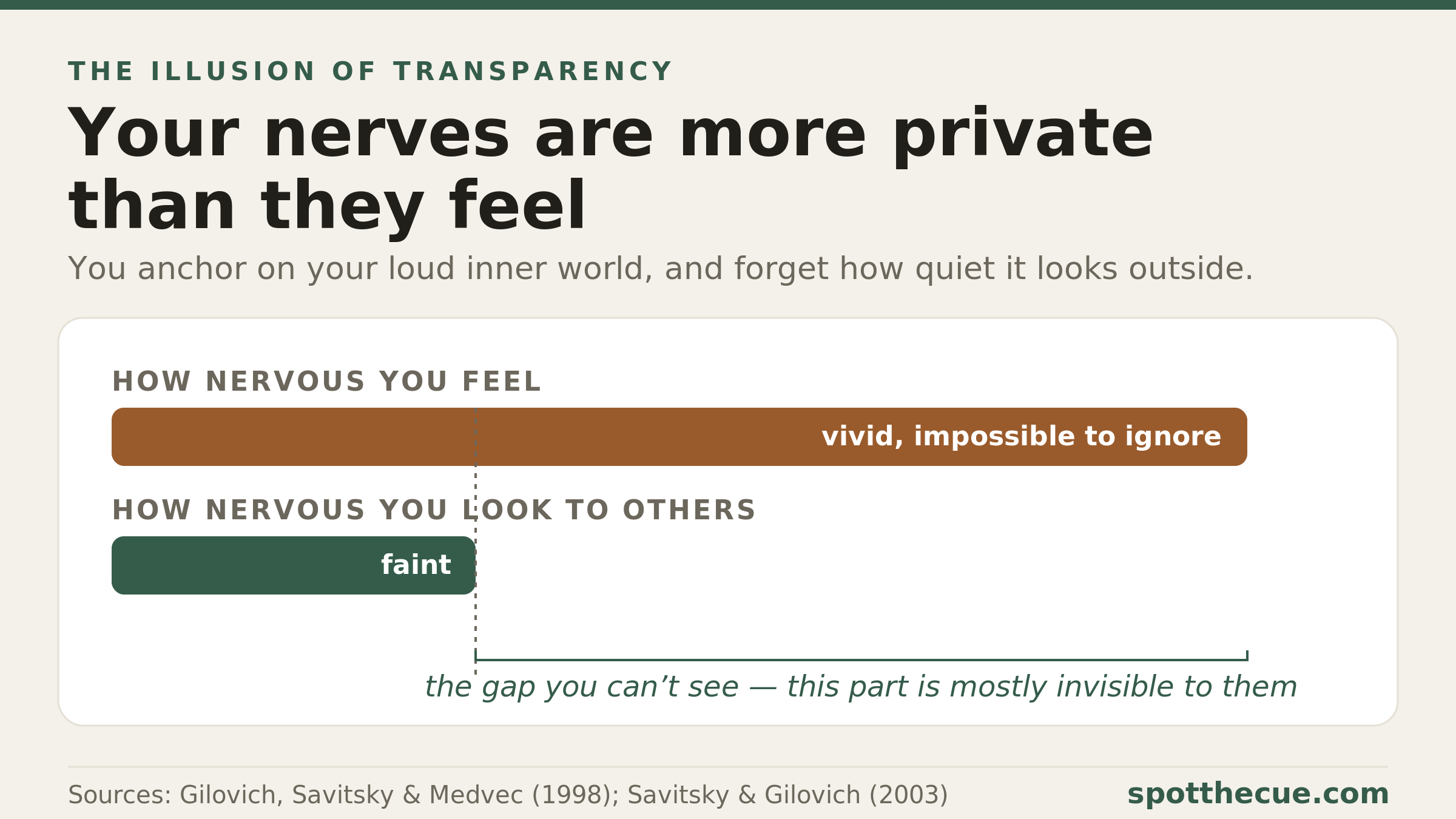
Your heart is pounding before you speak up in a meeting, and you’re certain it shows — your voice will shake, your face will flush, and everyone will know exactly how nervous you are. Then it’s over, and someone tells you that you seemed perfectly calm. That gap between how you felt and how you looked has a name. Psychologists call it the illusion of transparency: we routinely overestimate how well other people can read our inner states from the outside.1
What the research actually found
The original demonstration is almost uncomfortable to read about. Gilovich, Savitsky, and Medvec had participants tell lies and then estimate how obvious their lying was to observers. The liars were convinced they were transparent — that the deception was leaking out of their faces — but observers caught them far less often than the liars expected.1 In another study, people tasted a foul drink and were sure their disgust was written all over them; once again, observers could tell far less than the tasters assumed.1
Why does this happen? The researchers point to anchoring. Your own churning feelings are vivid and impossible to ignore, so you start from that intense inner experience and then adjust — insufficiently — when you try to imagine how you look from the outside. The feeling is loud on the inside, and you forget how quiet it is on the outside.14
Why this matters if you get nervous socially
For anyone who deals with social anxiety, the illusion of transparency isn’t a curiosity — it’s part of the machinery. Feeling that your anxiety is on full display makes you more anxious, which makes you more self-conscious, which makes you even more certain it shows. Research on socially anxious people finds the illusion of transparency behaves like a fairly general feature of that worry, showing up even in lower-pressure moments rather than only under intense scrutiny.5
The genuinely useful part
Here’s the encouraging turn. Simply learning that this bias exists appears to help. Savitsky and Gilovich had people give impromptu speeches; some were first told about the illusion of transparency and reassured that their nervousness would be much less visible than it felt. Those speakers not only felt better — they delivered speeches that both they and independent observers rated as better than the speeches of people who got no such information, or who were simply told to relax.2 Knowing your nerves are mostly private seems to free up the attention you’d otherwise spend trying to hide them.
Myth People can tell exactly how nervous I am.
What the research says Usually they can’t — not nearly as well as you assume. Your racing heart, dry mouth, and looping self-talk are intensely obvious to you and mostly invisible to everyone else. Across these studies, observers consistently judged people to be less nervous than those people felt, and less nervous than they were sure they looked.25
How to use this
Name the bias in the moment
When the thought “everyone can see I’m panicking” shows up, treat it as the illusion talking. The visible slice of your anxiety is a fraction of the felt version.
Aim your attention outward
Self-monitoring feeds the illusion. Put your focus on the other person or the point you’re making, not on scanning your own symptoms — it both calms the loop and makes you a better reader of them.
Don’t pre-apologize for nerves
“Sorry, I’m so nervous” hands people a label they probably weren’t applying. You almost always look more composed than you feel — let that impression stand.
Reality-check afterward
Ask someone you trust how you actually came across. The feedback is nearly always kinder than your prediction, and over time it recalibrates the bias.
The flip side worth knowing
The same bias runs in the other direction, and it’s easy to miss. Because your own meaning feels so obvious from the inside, you tend to assume your warmth, your gratitude, or your good intentions are plainly visible to others — when often they aren’t.4 The practical upshot is simple: when something matters, don’t rely on it showing. Say the kind thing, state the intention, make the appreciation explicit. What’s crystal clear to you is frequently invisible to everyone else.
Reading people well starts with an accurate read on how you’re being read — and most of us start out miscalibrated in a predictable direction. That’s exactly the kind of thing you can practice: our short scenarios let you rehearse noticing what actually shows versus what only you can feel, in low-stakes reps. It’s free to start and needs no sign-up.
Now try reading a cue under a little pressure.
Short scenarios, instant feedback — free to start, no sign-up.
Sources
- Gilovich, T., Savitsky, K., & Medvec, V. H. (1998). The illusion of transparency: Biased assessments of others’ ability to read one’s emotional states. Journal of Personality and Social Psychology, 75(2), 332–346. Link ↗
- Savitsky, K., & Gilovich, T. (2003). The illusion of transparency and the alleviation of speech anxiety. Journal of Experimental Social Psychology, 39(6), 618–625. Link ↗
- Gilovich, T., Medvec, V. H., & Savitsky, K. (2000). The spotlight effect in social judgment: An egocentric bias in estimates of the salience of one’s own actions and appearance. Journal of Personality and Social Psychology, 78(2), 211–222. Link ↗
- Gilovich, T., & Savitsky, K. (1999). The spotlight effect and the illusion of transparency: Egocentric assessments of how we are seen by others. Current Directions in Psychological Science, 8(6), 165–168. Link ↗
- Brown, M. A., & Stopa, L. (2007). The spotlight effect and the illusion of transparency in social anxiety. Journal of Anxiety Disorders, 21(6), 804–819. Link ↗