Reading the Voice: Why Your Ears May Catch Feelings Your Eyes Miss
We fixate on faces, but a lot of emotion rides in the sound of a voice — and taking the face away can sharpen the read. Here’s what the research shows, and where it gets oversold.
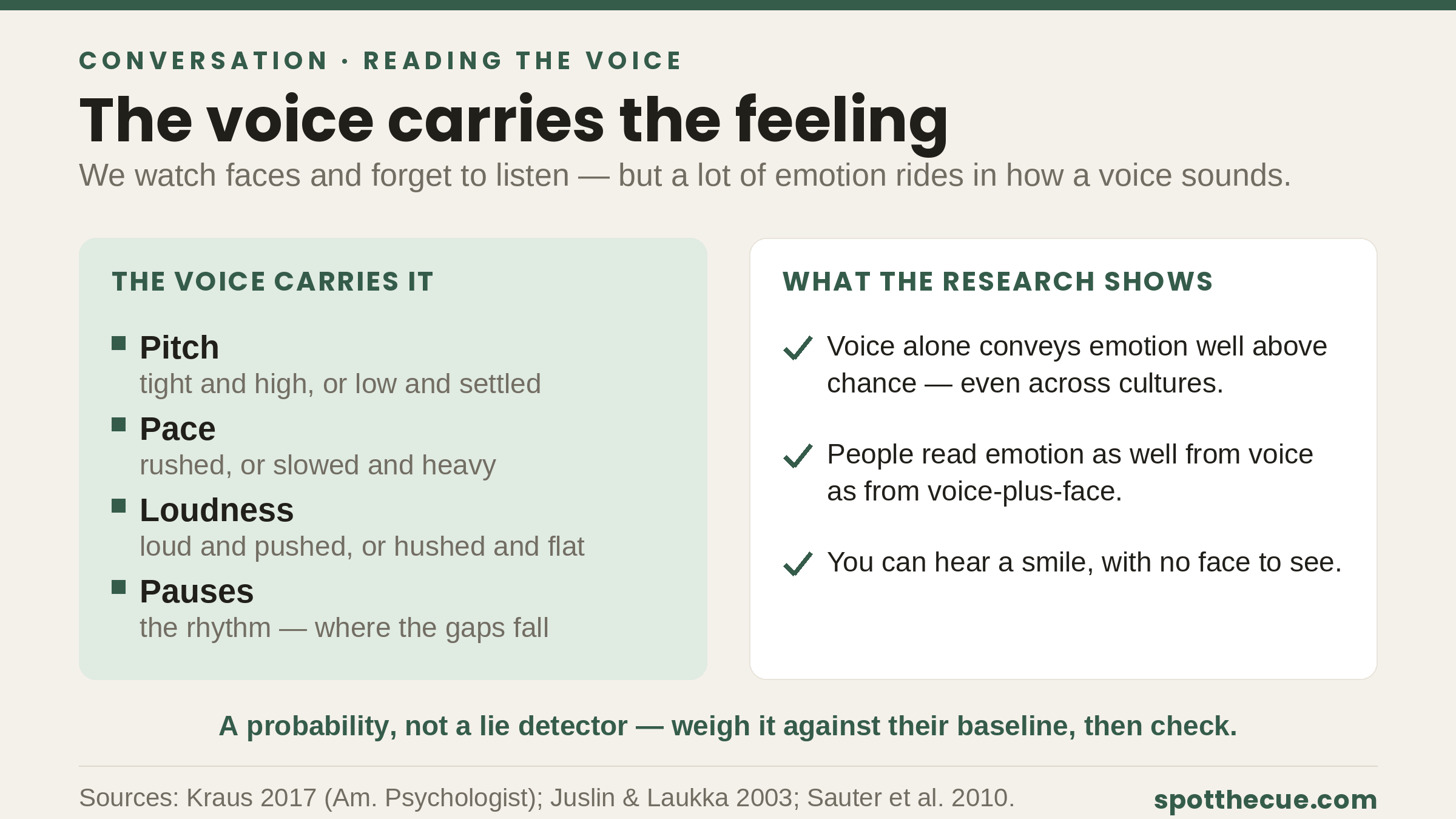
We watch faces and forget to listen
Most advice about reading people points at the face — the eyes especially, the supposed "windows to the soul." But a great deal of emotion never touches the face at all; it rides in the paralinguistics: pitch, tempo, loudness, rhythm, and voice quality — the "how" wrapped around the "what." A meta-analysis of more than a hundred studies of vocal expression found that discrete emotions — anger, fear, happiness, sadness, tenderness — are communicated through the voice at accuracy well above chance, each with its own recognizable acoustic signature.3
And some of that signal travels remarkably far. When researchers played brief nonverbal vocalizations — laughs, screams, sighs — to Western listeners and to members of a remote, culturally isolated Namibian community, both groups recognized each other’s basic-emotion sounds well above chance, even with no shared language or media.4 The voice also carries fine distinctions, not just good-versus-bad: from short "vocal bursts" alone, people can tell apart states as subtle as awe, compassion, interest, and embarrassment.5
The counterintuitive finding: listening can rival looking
Here is the part that surprises people. Across five experiments with roughly 1,800 participants, Michael Kraus found that people judged others’ emotions at least as accurately — and in several studies more accurately — when they only heard a voice than when they could see the person’s face, or see the face and hear the voice together.1 His proposed explanation is simple: strip away the face, and attention concentrates on the channel that is actually doing much of the emotional work.
You can actually hear a smile
One vivid demonstration: researchers recorded speakers saying the same sentence while genuinely smiling, politely smiling, suppressing a smile, or not smiling — then played the clips to listeners with no picture. People could reliably tell the smiling voices from the non-smiling ones, and did best with genuine, felt smiles.6 The effect even loops back into your own body: hearing a "smiling" voice nudges a listener’s own smile muscles to activate, unconsciously.7 A warm voice does real work, even over a phone line.
Myth You can’t really tell how someone feels unless you can see their face.
What the research says The voice is a rich emotional channel in its own right. In lab studies, people read emotion from voice alone at least as accurately as from seeing the person — the acoustic shape of a feeling often gives it away, like the tight, higher, faster voice of anxiety or the low, slow, quiet one of sadness.13 Whether the voice truly beats the face is still debated, but "I need to see their face to know" simply isn’t supported.
What to listen for
Attend to the "how," not just the "what"
Pitch (tight and high vs. low and settled), pace (rushed vs. slowed), volume, and the pattern of pauses carry the feeling. When the words and the voice disagree, the voice is usually the more honest channel.
Try taking the face away
For a hard conversation, a phone call can actually help — with no expression to watch, your attention lands on tone. Voice-only isn’t colder; it can focus you on the channel doing the emotional work.
Anchor on their baseline
A voice that’s suddenly flatter, faster, higher, or quieter than this person’s own normal is the real signal — more telling than any textbook "sad voice." Listen for the change from them, not from a template.
Hold it as odds, not proof
A shaky voice can be nerves, a head cold, or too much coffee. Vocal cues raise or lower the probability of a feeling; they don’t confirm it. Read them alongside words and context, then check.
The honest limits
Reading the voice is a probability skill, not a superpower. Accuracy is far from perfect, and it isn’t evenly distributed: a meta-analysis found an in-group advantage — people read vocal emotion more accurately when the speaker shares their language or cultural background, and less well across those lines.8 Tone is also easy to misattribute; a curt reply can be a bad day rather than disapproval of you. And none of this is a way to "detect lies" from someone’s voice — that promise doesn’t hold up any better for the ears than it does for the eyes. Treat the voice as one more clue to weigh, generously.
The encouraging part is that most of reading the voice is just remembering to listen for it — the cue is usually there; we’re busy watching the face. Building the habit of weighing tone alongside words and expression, and then checking instead of concluding, is exactly the kind of low-stakes rep Spot the Cue is built for. It’s free to start and needs no sign-up.
Now try reading a cue under a little pressure.
Short scenarios, instant feedback — free to start, no sign-up.
Sources
- Kraus, M. W. (2017). Voice-only communication enhances empathic accuracy. American Psychologist, 72(7), 644–654. Link ↗
- Rossiter, J. R. (2018). Voice-only does not meaningfully improve detection of emotions: Comment on Kraus (2017). American Psychologist, 73(5), 689–690. (See also Kraus’s reply, pp. 691–692.) Link ↗
- Juslin, P. N., & Laukka, P. (2003). Communication of emotions in vocal expression and music performance: Different channels, same code? Psychological Bulletin, 129(5), 770–814. Link ↗
- Sauter, D. A., Eisner, F., Ekman, P., & Scott, S. K. (2010). Cross-cultural recognition of basic emotions through nonverbal emotional vocalizations. PNAS, 107(6), 2408–2412. Link ↗
- Simon-Thomas, E. R., Keltner, D. J., Sauter, D., Sinicropi-Yao, L., & Abramson, A. (2009). The voice conveys specific emotions: Evidence from vocal burst displays. Emotion, 9(6), 838–846. Link ↗
- Drahota, A., Costall, A., & Reddy, V. (2008). The vocal communication of different kinds of smile. Speech Communication, 50(4), 278–287. Link ↗
- Arias, P., Belin, P., & Aucouturier, J.-J. (2018). Auditory smiles trigger unconscious facial imitation. Current Biology, 28(14), R782–R783. Link ↗
- Laukka, P., & Elfenbein, H. A. (2021). Cross-cultural emotion recognition and in-group advantage in vocal expression: A meta-analysis. Emotion Review, 13(1), 3–11. Link ↗