Can You Actually Tell When Someone Is Lying? (The Honest Answer)
Apps and courses promise to teach you deception detection from body language. Six decades of research say the tells they teach do not work — and the thing that does work is not what anyone is selling.
The promise
Search for a body-language app and you will be told you can learn to "spot deception instantly," "read the tells that 99% of people miss," or "master the science of lie detection." It is a compelling pitch: the idea that truth leaks out of the body whether people want it to or not. It is also, as far as six decades of research can tell, mostly wrong.
What the research actually found
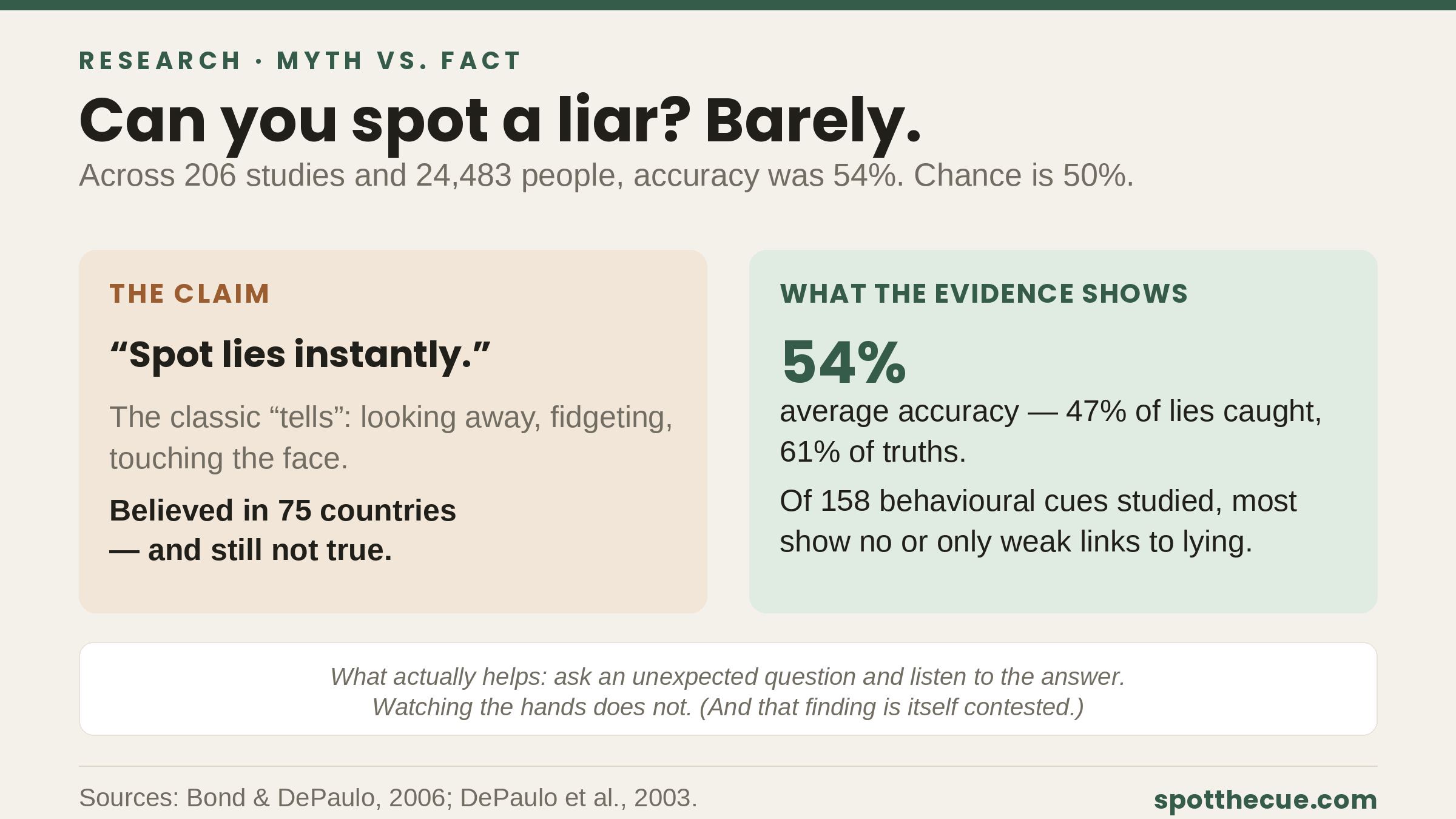
The definitive number comes from a meta-analysis by Charles Bond and Bella DePaulo, which pooled 206 studies and 24,483 judges. People trying to tell lies from truths in real time, without special aids, were correct 54% of the time — against a 50% baseline. They caught 47% of lies and correctly cleared 61% of truths.1
There is no reliable tell
A second meta-analysis went looking for the cues themselves, examining 1,338 estimates across 158 different behaviors — gaze, fidgeting, pauses, posture, hand movements, the lot. The conclusion was that many behaviors have no discernible link, or only a weak one, to deceit. Liars were somewhat less forthcoming and seemed a little more tense, but nothing came close to a usable signal in a single conversation.2
Myth “Liars can’t look you in the eye.”
What the research says This is the single most widespread belief about lying on Earth. A study across 75 countries and 43 languages found "liars avert gaze" to be the dominant pan-cultural stereotype.3 It is also not supported: gaze aversion does not reliably distinguish liars from truth-tellers. A near-universal belief and a real cue are different things — and someone who knows the stereotype can simply hold your gaze.
But some people are naturally gifted, right?
This is the usual rescue for the idea, and it has been tested directly. Bond and DePaulo examined whether accuracy varies meaningfully between individuals — whether "human lie detectors" exist. They found that differences between judges were remarkably small, far smaller than the folklore suggests. People differ much more in how suspicious they are than in how accurate they are.4
Which produces a genuinely uncomfortable pattern: training and experience tend to raise confidence considerably more than they raise accuracy. Someone who has taken a body-language course is not much better at catching liars — they are just more sure of themselves, and more likely to accuse an innocent person.
What does move the needle
There is a real finding here, and it is about how you ask, not what you watch. A meta-analysis of the "cognitive approach" — imposing cognitive load, pressing for more detail, and asking unanticipated questions — reported accuracy of around 71% versus 56% for standard approaches.5 The logic is that inventing a coherent, detailed, internally consistent account under unexpected questioning is genuinely harder than recalling one.
Ask, don’t watch
If something genuinely does not add up, ask an open question you had not signalled in advance and listen to the answer. The content is more informative than the hands.
Check the story, not the person
Verifiable detail — times, names, sequence — is checkable. A nervous swallow is not. Nervousness under suspicion is the most normal thing in the world.
Notice your own certainty
The feeling of "I can tell" is the least reliable part of the process. Confidence and accuracy are close to unrelated here.
Weigh the cost of being wrong
Accusing someone honest is a real harm with a real probability attached. At 54% accuracy, that probability is high.
What we teach instead of tells
Spot the Cue is built on reading emotional state and engagement — whether someone is uncomfortable, losing interest, softening, or holding something back. Those reads are genuinely trainable, and we say so with the caveats attached: a cue "often means" something, not always. Deception is a different problem. The evidence says the signal mostly is not there, so teaching you to see it would mean teaching you to be confidently wrong.
That distinction matters more than it sounds. Most of what people actually want when they say "I want to read people" is not catching liars — it is knowing whether someone is enjoying the conversation, whether a "sure, fine" was really fine, whether they should push or let it go. Those are answerable questions, and practicing them is time much better spent. It is free to start and needs no sign-up.
Now try reading a cue under a little pressure.
Short scenarios, instant feedback — free to start, no sign-up.
Sources
- Bond, C. F., Jr., & DePaulo, B. M. (2006). Accuracy of deception judgments. Personality and Social Psychology Review, 10(3), 214–234. Link ↗
- DePaulo, B. M., Lindsay, J. J., Malone, B. E., Muhlenbruck, L., Charlton, K., & Cooper, H. (2003). Cues to deception. Psychological Bulletin, 129(1), 74–118. Link ↗
- The Global Deception Research Team. (2006). A world of lies. Journal of Cross-Cultural Psychology, 37(1), 60–74. Link ↗
- Bond, C. F., Jr., & DePaulo, B. M. (2008). Individual differences in judging deception: Accuracy and bias. Psychological Bulletin, 134(4), 477–492. Link ↗
- Vrij, A., Fisher, R. P., & Blank, H. (2017). A cognitive approach to lie detection: A meta-analysis. Legal and Criminological Psychology, 22(1), 1–21. Link ↗
- Levine, T. R., et al. (2018). A critical look at meta-analytic evidence for the cognitive approach to lie detection: A re-examination of Vrij, Fisher, and Blank (2017). Legal and Criminological Psychology. (See also Vrij, Blank, & Fisher’s reply in the same journal.) Link ↗
- Brennen, T., & Magnussen, S. (2023). Lie detection: What works? Current Directions in Psychological Science, 32(5), 395–401. Link ↗